Grady-White

Filters

Filters

Location

from

Boat Type

Condition

Searching boats for you...

Grady-White – Technical and Historical Guide


ABOUT THIS BOAT BRAND

Grady-White is an American boat manufacturer renowned for producing rugged, safety-focused saltwater and coastal vessels since its founding in 1959 by Don White and Glen Grady. Built on a philosophy of offshore capability and long-term value, the company’s signature SeaV2 hull and attention to fit and finish have defined its product line for more than six decades. Headquartered in Greenville, North Carolina, Grady-White has been privately owned by Eddie Smith since 1968 and maintains a strong reputation reflected in measurable industry recognition, including the National Marine Manufacturers Association Customer Satisfaction Index award for 22 consecutive years. With a model range that includes center console fishing boats from about 18 to 36 feet and purpose-built coastal and cabin offerings, Grady-White’s track record and long-running awards serve as trust indicators of its significance in the recreational and sportfishing markets.

Specializing in outboard-powered saltwater boats, Grady-White targets serious offshore anglers and family boaters who demand dependable, ocean-capable performance. The brand’s core offerings include center consoles (Fisherman and Canyon series), dual consoles and family-focused Freedom models, and offshore express cabins such as the new Express 340 introduced in 2025. Historical roots in sportfishing and practical coastal design inform their boats’ features: the patented SeaV2 deep-V hull form for improved ride and stability, multi-engine outboard configurations for redundancy and power, integrated fish systems including insulated fish boxes and pump-driven livewells, reinforced stainless-steel hardware and high gunnels for safety, and electronics-ready helms with durable marine wiring and self-bailing cockpits. These design choices and proven technical elements make Grady-White a preferred choice for tournament fishing competitors and families seeking reliable offshore capability and long-term resale value.

WHAT MAKES THIS BOAT BRAND SPECIAL?

Grady-White sets itself apart with the patented SeaV²® variable deadrise hull and a history of practical innovations such as the original walkaround cabin, delivering predictable handling and a softer ride in big water. The SeaV²® hull combines a fine entry forward with flatter aft sections to slice waves, plane efficiently, and dampen pounding and spray, giving anglers and cruisers confident control in offshore chop; paired with unsinkable closed-cell foam flotation and a hand-laid solid fiberglass hull this architecture provides buoyancy, impact resistance, and stable secondary stability. Grady-White builds hulls using proven layup schedules and a robust internal grid so boats track true, respond with precise helm feel, and maintain fuel-efficient cruise speeds; owners report controlled acceleration, minimal hobby-horsing, and responsive handling in mixed sea states. Practical details like protected helm layouts, ergonomic cockpit flow, integrated fish boxes and livewells, and weather-ready cabin access make Grady-White boats well suited for coastal and offshore fishing as well as family cruising and long weekend passages.

Manufactured in Greenville, North Carolina, Grady-White combines a legacy that dates to 1959 with a skilled workforce focused on fit and finish and coachbuilt-style attention to detail. The company uses premium materials including hand-laid solid fiberglass, marine-grade stainless steel hardware, high-performance gelcoats, and closed-cell unsinkable foam flotation, and assembles systems to meet or exceed ABYC and U.S. Coast Guard standards; many models carry industry recognition and Grady-White has earned consecutive NMMA Customer Satisfaction (CSI) awards. Backed by an industry-respected limited warranty and a nationwide dealer and service network, Grady-White subjects each hull to sea trials and rigorous quality checks, producing consistent build quality and longevity. Owners consistently praise Grady-White for durability, reliability, and strong resale value, perceptions that reinforce Grady-White's position as a leader in ruggedly elegant coastal and offshore fishing boats.

WHAT DIFFERENT TYPES OF BOATS DOES THIS BOAT BRAND BUILD?

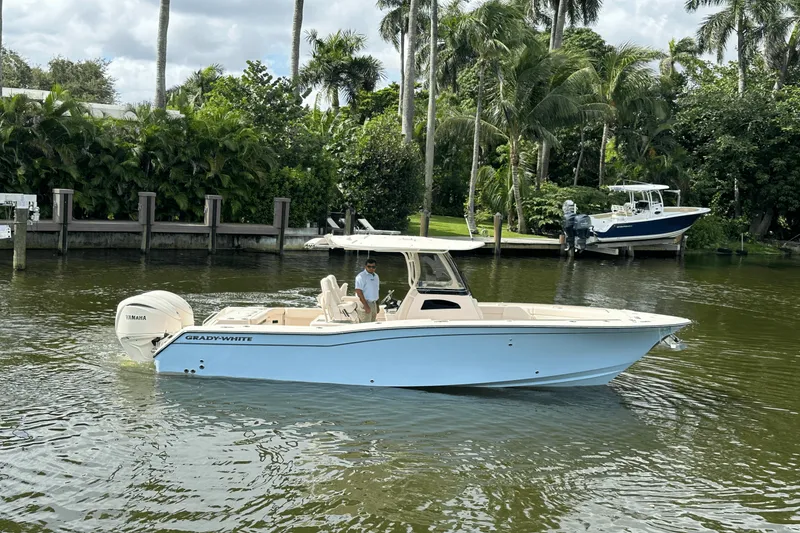
Grady-White builds a focused range of primarily outboard-powered saltwater boats spanning roughly 18 to 45 feet, organized into five main categories: Center Consoles, Coastal Explorers, Dual Consoles, Express Cabins and Walkaround Cabins. From the compact Fisherman 180 to flagship Canyon and Freedom center-console and dual-console models near 45 feet, the line emphasizes fishability, family comfort and offshore capability. Most models use single to multiple outboard engines, with larger flagships offering twin or quad outboard arrangements. Grady-White’s proprietary SeaV²® hull with variable deadrise delivers a dry, stable ride and enables shallow-draft Coastal Explorers as well as high-fuel, long-range express and center-console performance. Below are the types of boats and models Grady-White builds, along with their key characteristics and uses:

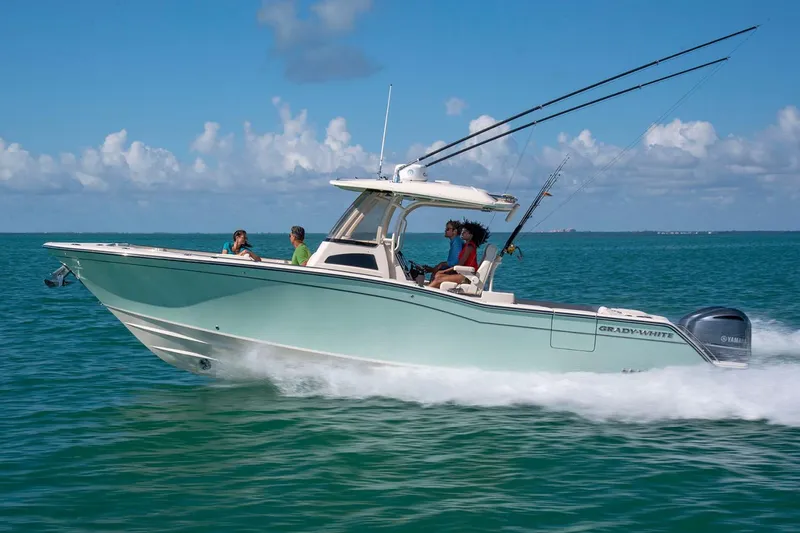
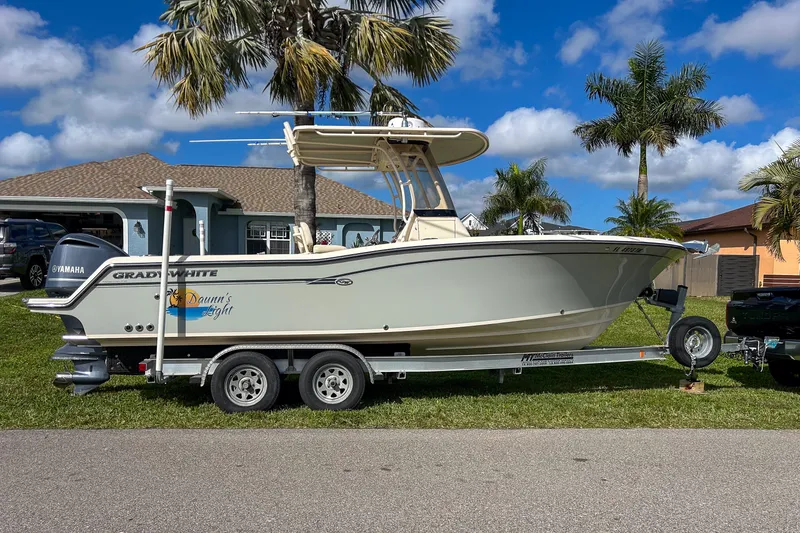
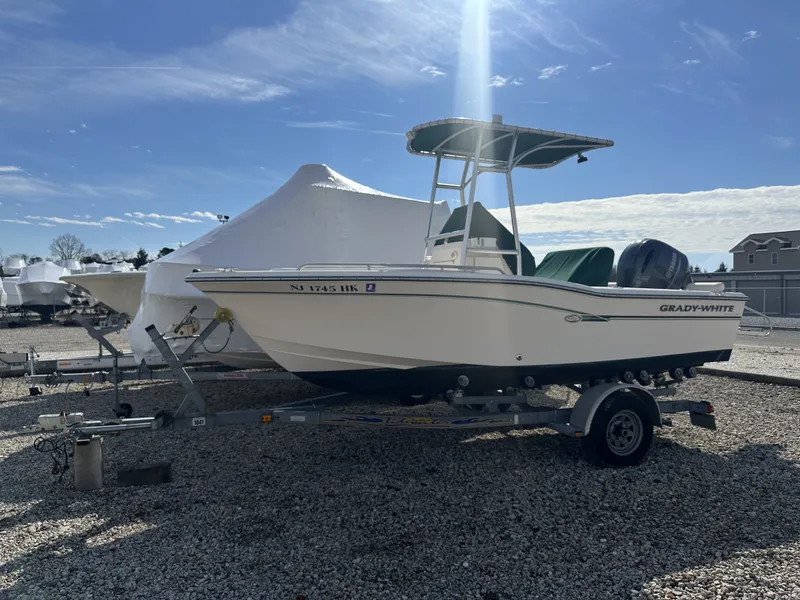
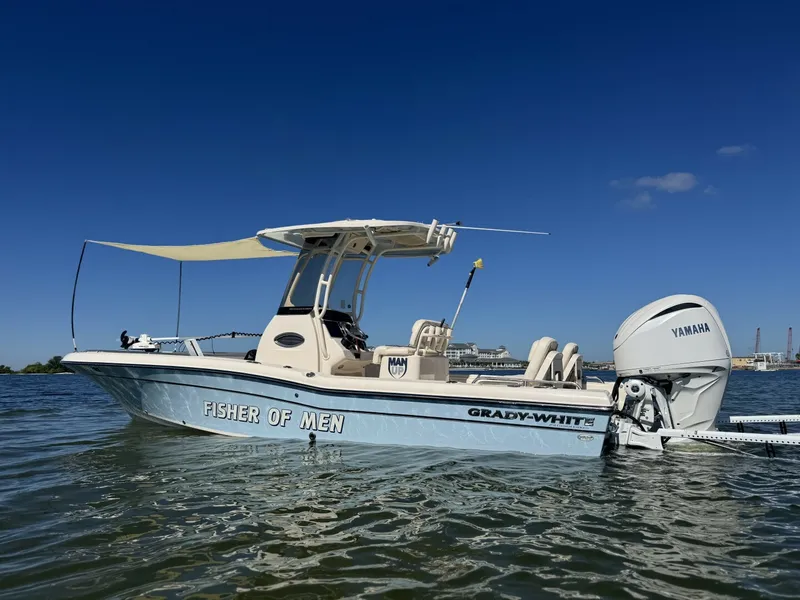
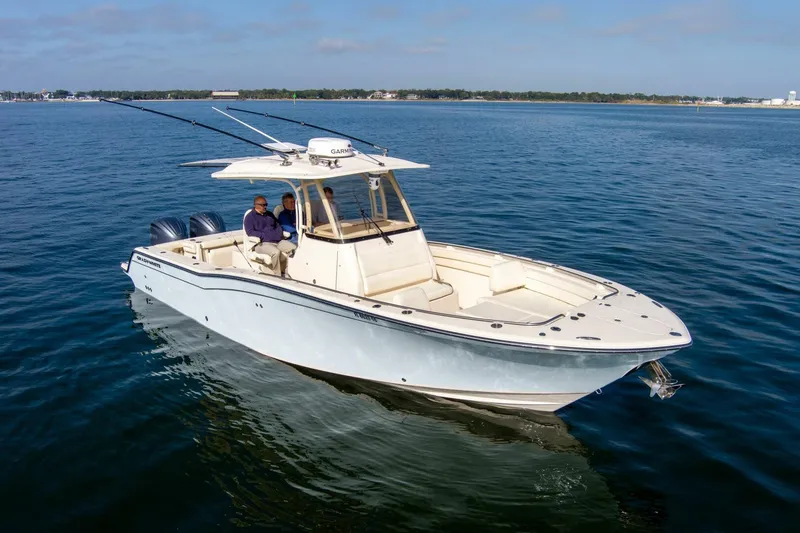
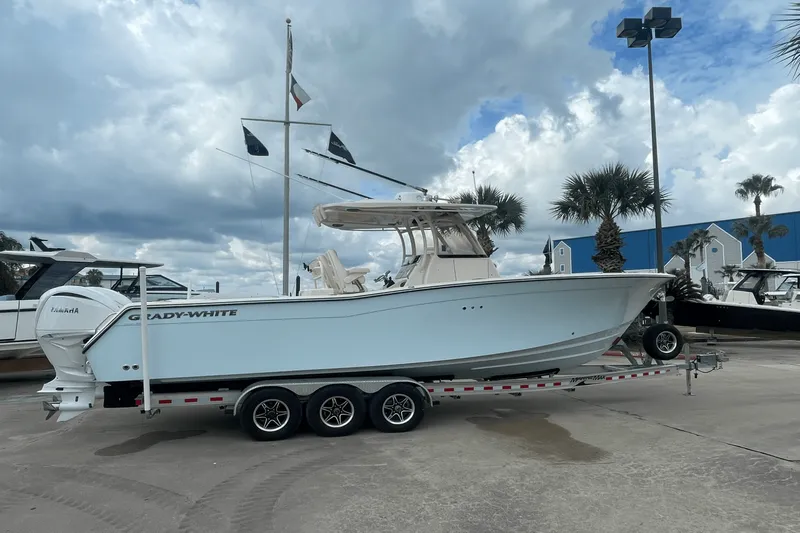
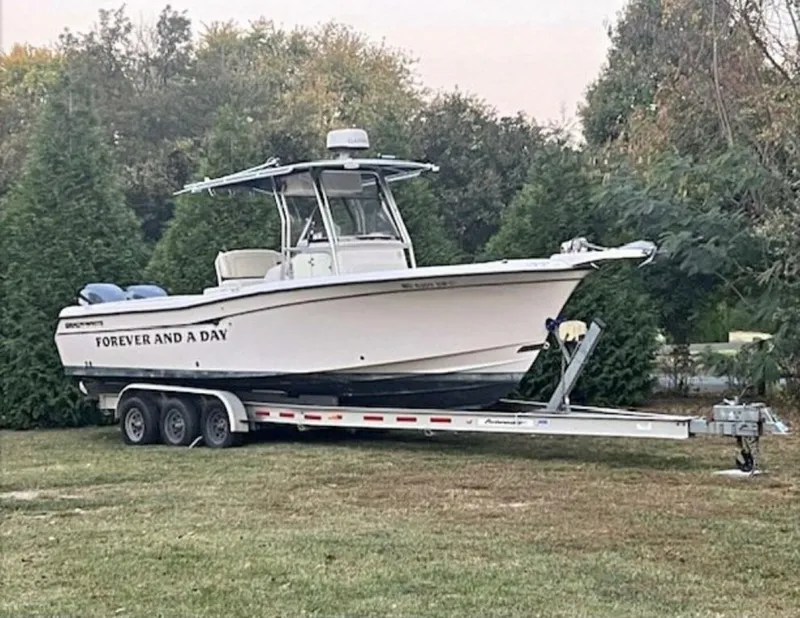
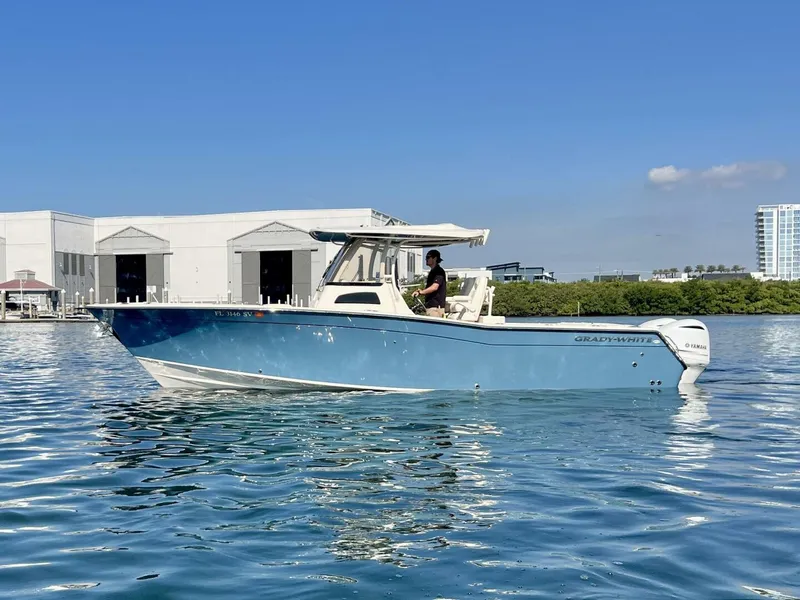
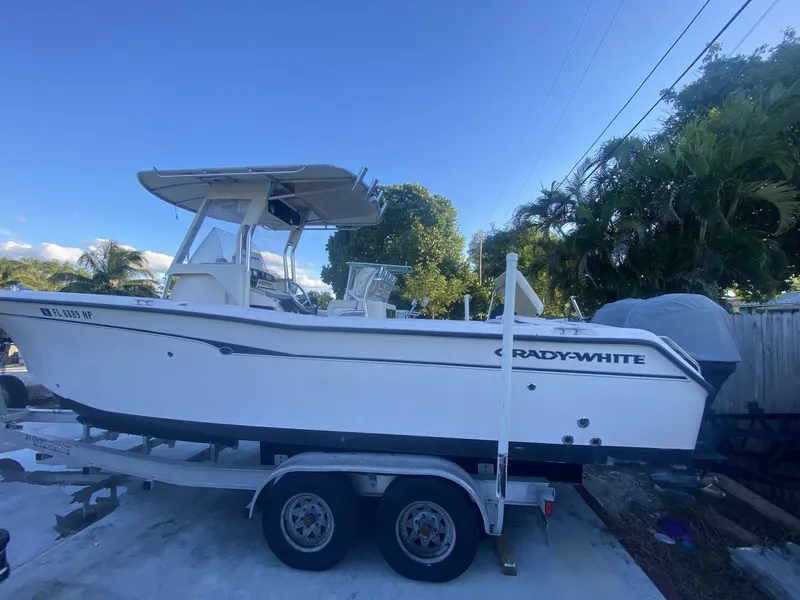
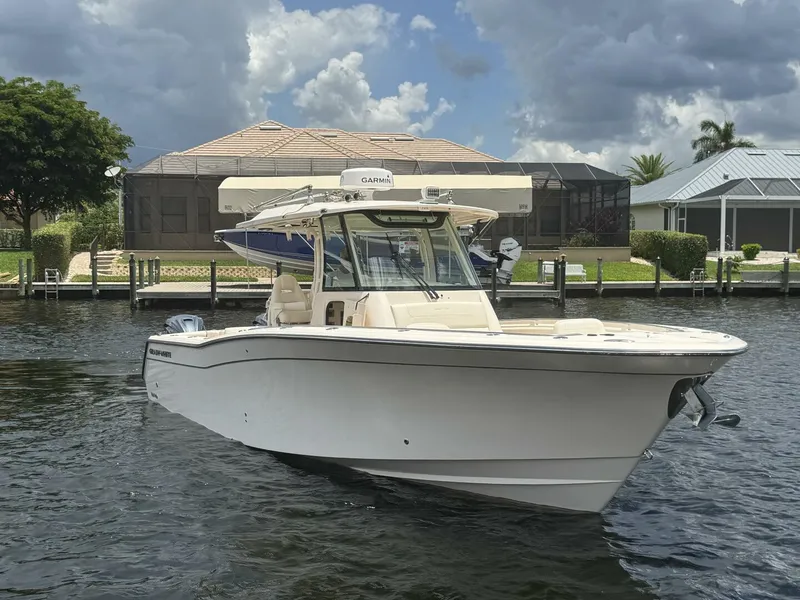
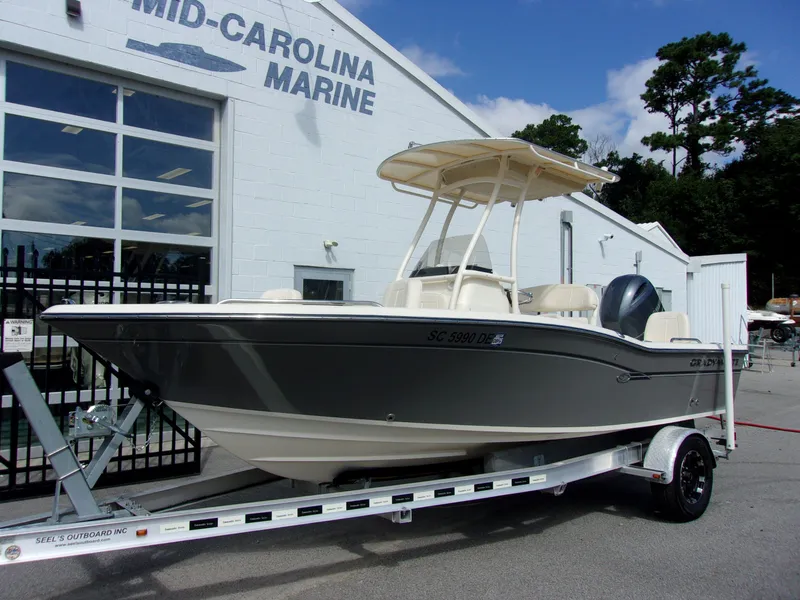
• (Center Consoles) Grady-White's Center Consoles span the stated size range of 18′ to 45′ and include specific models whose exact lengths illustrate that breadth, from the Fisherman 180 at ≈17′10" to the Fisherman 236 at ≈23′7" (≈25′7" with swim platform), the Canyon 336 at ≈33′6" centerline and the flagship Canyon 456 at ≈45′ centerline. These models ride on the proprietary SeaV² continuously variable deadrise hull, a Ray Hunt design that combines a variable deadrise hull form with outboard propulsion to deliver a dry, stable ride and reduced spray. Beam measurements such as 7′5" on the Fisherman 180, 8′6" on the Fisherman 236 and 11′7" on the Canyon 336, and draft figures where provided, define a hull geometry that supports large cockpits and fuel capacities ranging from 54 gal to 616 gal on the largest Canyon 456. Fishability is emphasized through features noted across the line including extensive rod storage, insulated fish boxes and livewells, and layouts optimized for anglers, while hardtops and available leaning posts preserve sightlines and protection underway. With predominant outboard power from single engines on smaller models up to quad arrangements on flagships, the Center Consoles are intended for serious offshore and inshore fishing, utility cruising and long days on the water, and they stand apart from competitors through their SeaV² hull, outboard-focused engineering and saltwater-tough construction and flotation systems.

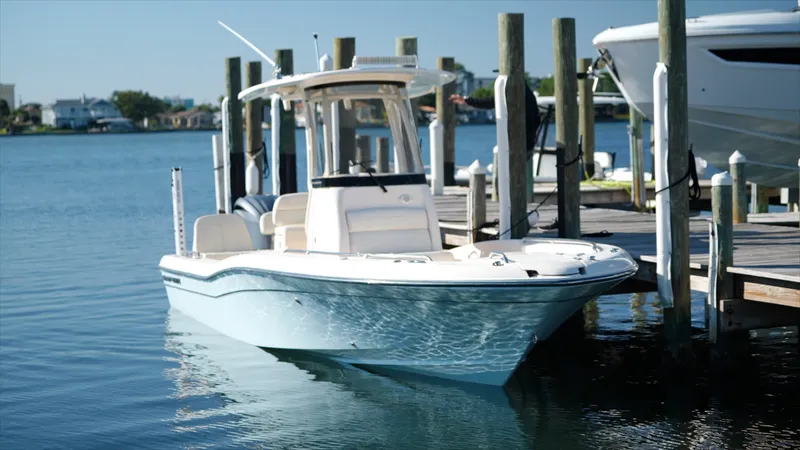
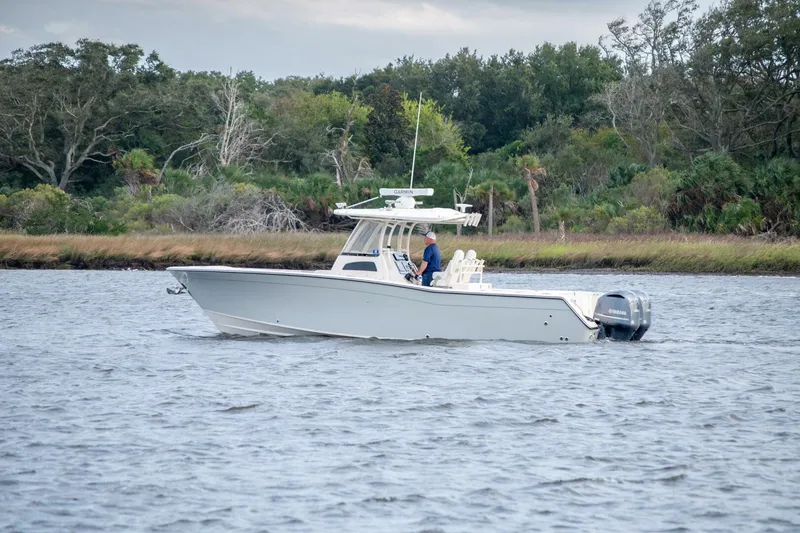
(Coastal Explorers) The Coastal Explorers line covers the precise 23′ to 28′ size range and is represented in the technical data by the 231 CE with an LOA of 23′, a 16" draft and an approximate 70 gal fuel capacity matched to a 300 HP outboard. Designed for shallow-water and inshore exploration, these models leverage the SeaV² continuously variable deadrise hull to balance soft seakeeping and reduced spray with the shallow running characteristics needed for flats fishing and tight-channel cruising. While beam figures are not provided for every Coastal Explorer in the supplied data, the recorded draft and fuel numbers indicate a compact, efficient platform suited to day trips, skiff-style access and maneuvering in protected waters. Interior and deck arrangements favor multi-use ownership with seating and storage options that accommodate both family cruising and angling, and Grady-Whites emphasis on insulated fish boxes, livewells and rod storage can be carried into Coastal Explorer layouts configured for fishing. The use of outboard propulsion simplifies systems and contributes to shallow-water operability, and the combination of the SeaV² hull and saltwater-tough construction positions Coastal Explorers to offer a premium, highly capable shallow-draft alternative to more generic shallow-water hulls. Owners commonly choose configurations that prioritize storage, seating and heads or galley options for comfortable long days.

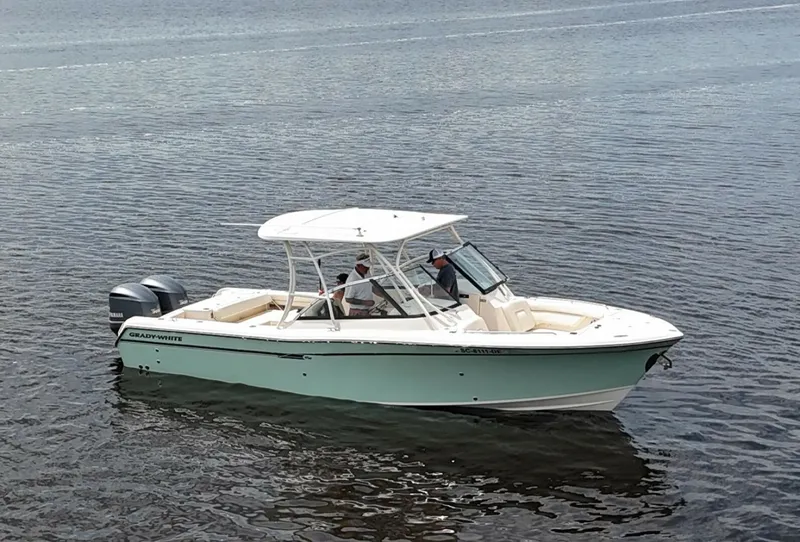
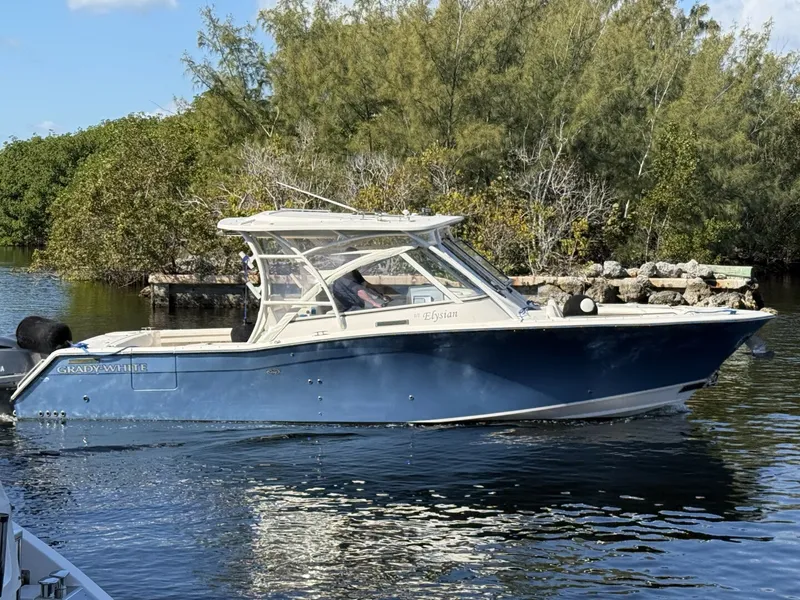
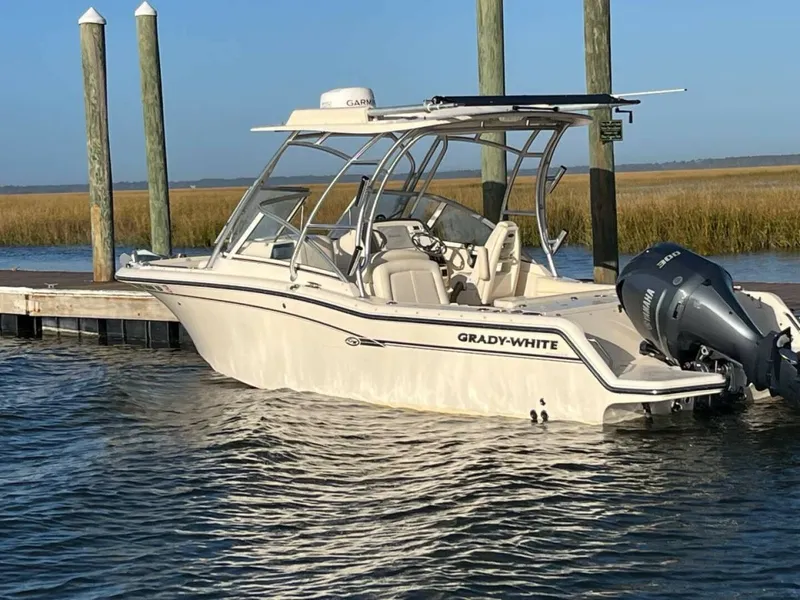
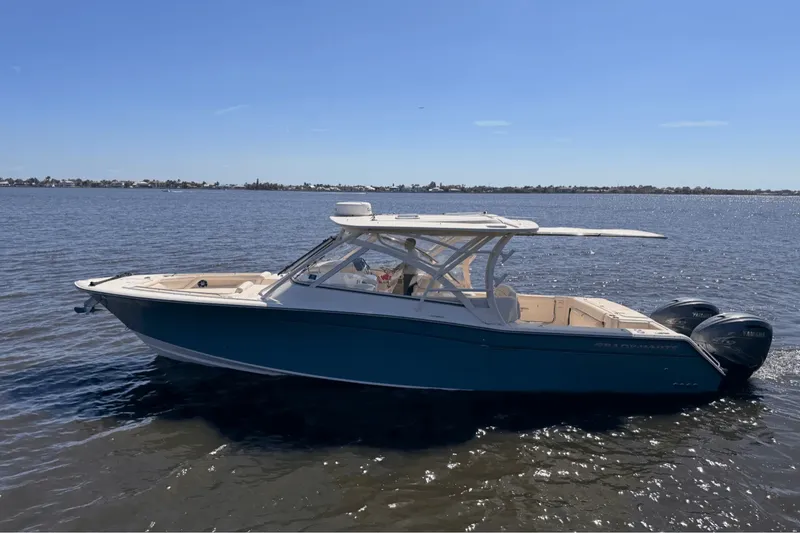
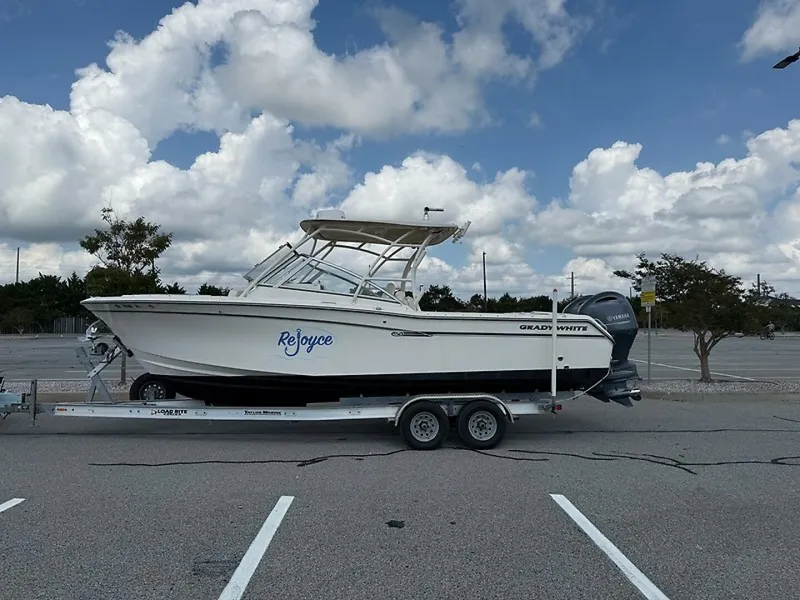
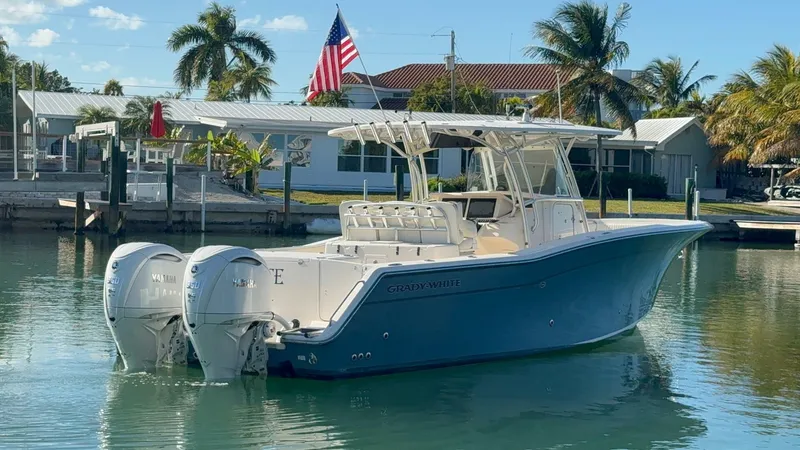
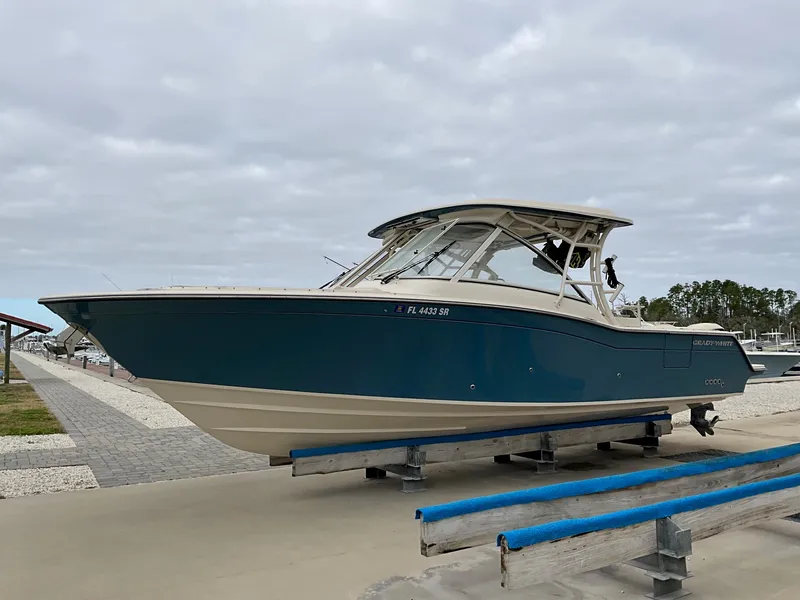
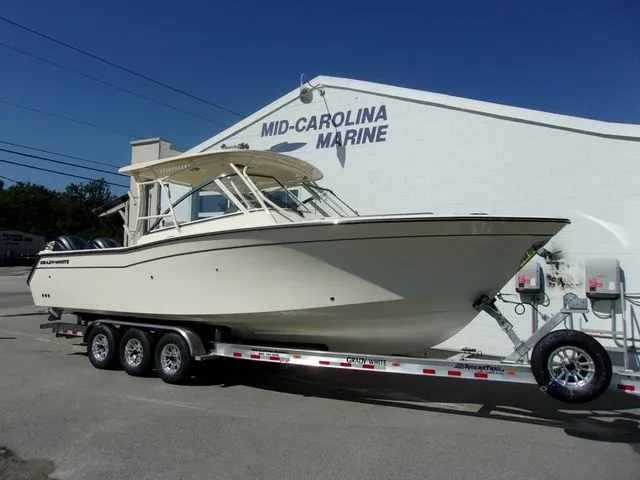
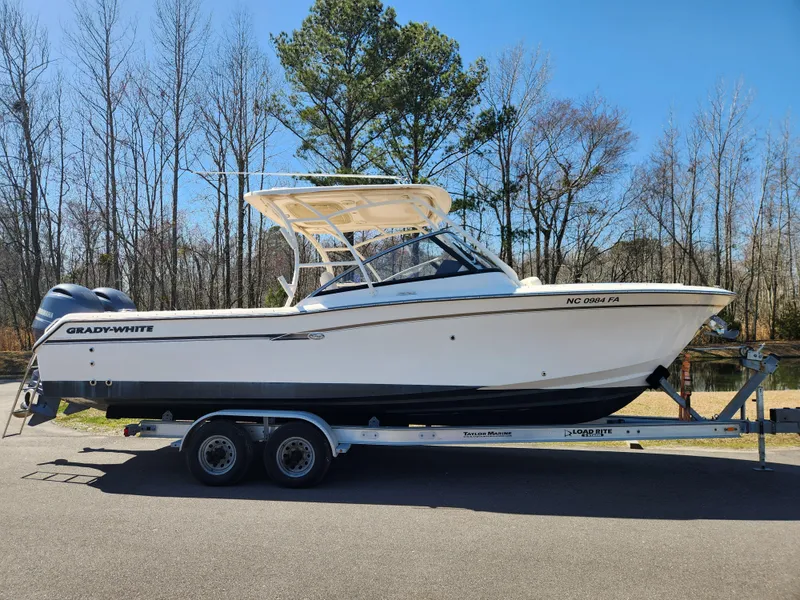
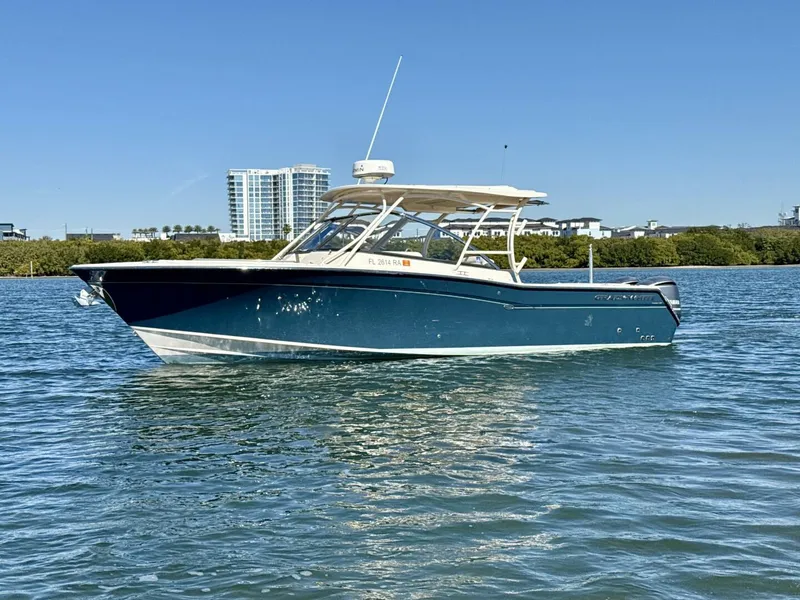
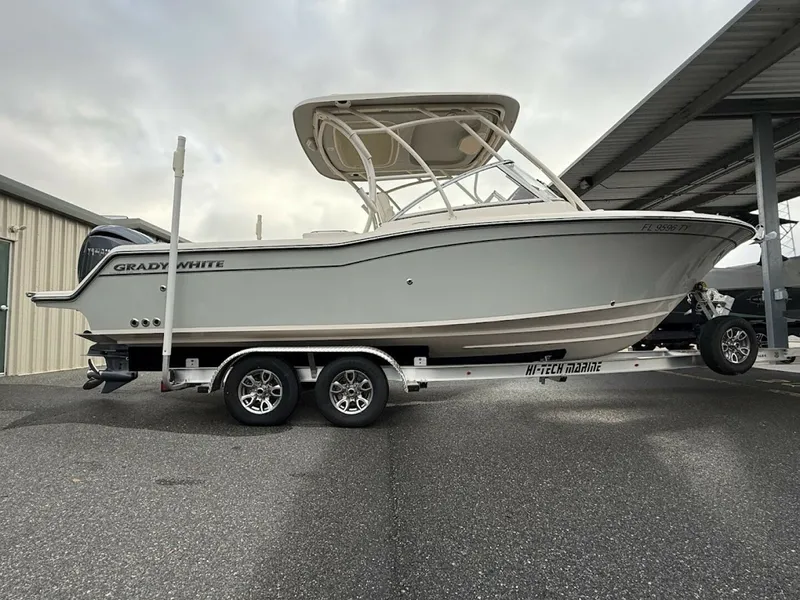
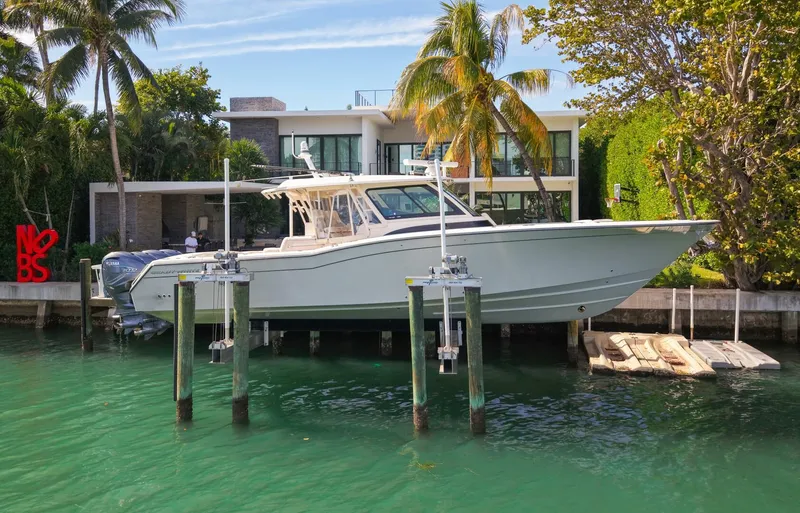
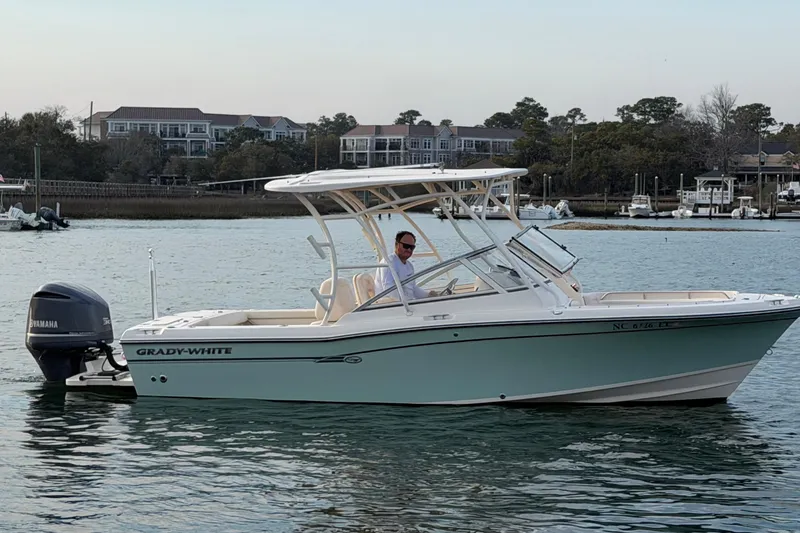
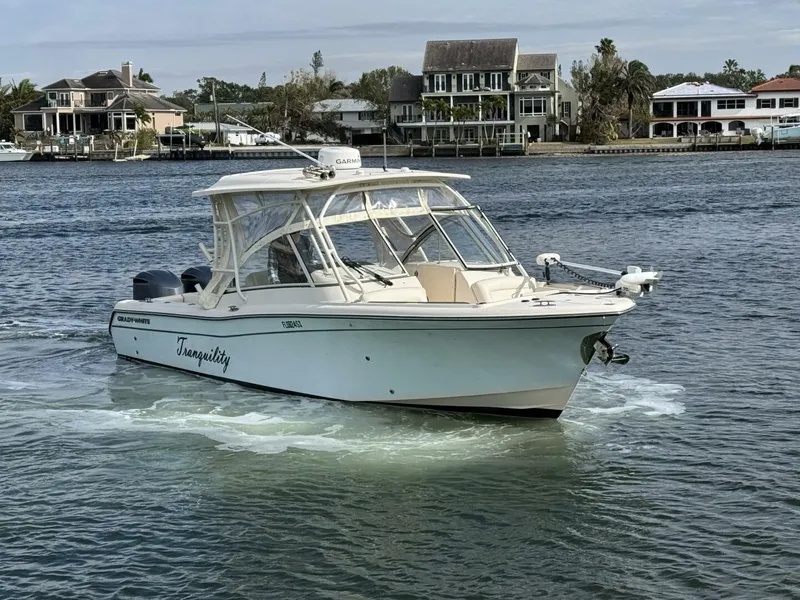
(Dual Consoles (Freedom Series)) The Freedom Series dual consoles cover the documented 21′ to 41′ size range and include exact technical entries such as the Freedom 235 at ≈23′7" (≈25′7" with swim platform), the Freedom 285 at ≈28′ centerline and the Freedom 415 at ≈40′7" centerline. Hull dimensions noted in the data show beams of 8′6" on the Freedom 235, 9′6" on the Freedom 285 and 13′8" on the Freedom 415, with drafts of 20" and 22" on the smaller twin-hull options and a 34" draft listed for the larger Freedom 415, supporting fuel capacities from 100 gal up to 520 gal and horsepower ranging from 350 HP through twin 700 HP arrangements to 1,800 HP on the largest. All benefit from Grady-Whites SeaV² continuously variable deadrise hull for predictable, dry performance and reduced spray, while the dual-console layout is expressly aimed at owners who want both family comfort and fishability. Deck and cabin configurations accommodate seating, heads and galley choices for overnight or weekend use, while fishing-oriented arrangements retain insulated fish boxes, livewells and dedicated rod storage so anglers do not surrender utility. With predominant outboard propulsion and a saltwater-tough build, Freedom dual consoles are positioned to serve multi-use owners who need a boat capable of cruising, overnighting and tackling offshore fishing days without compromising on comfort or seaworthiness.

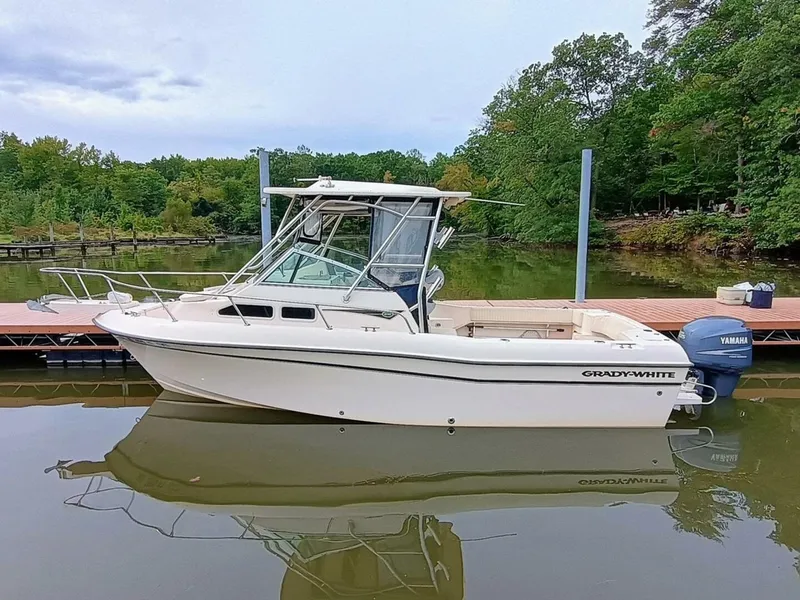
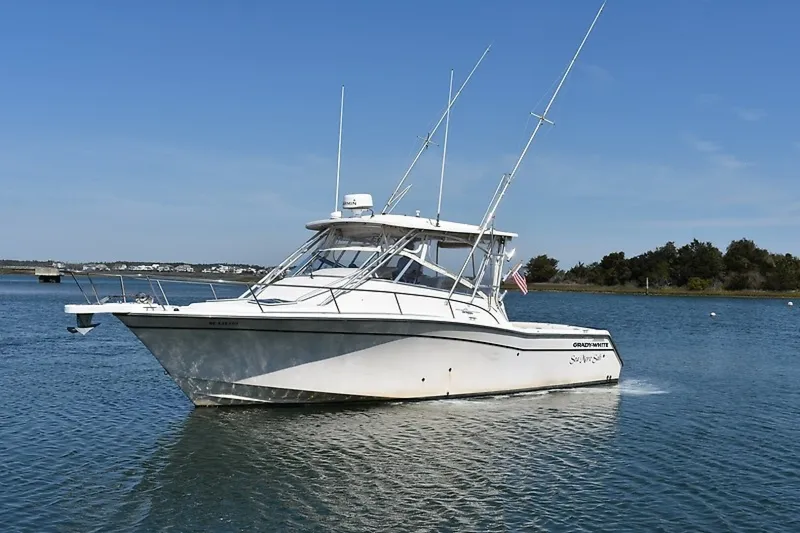
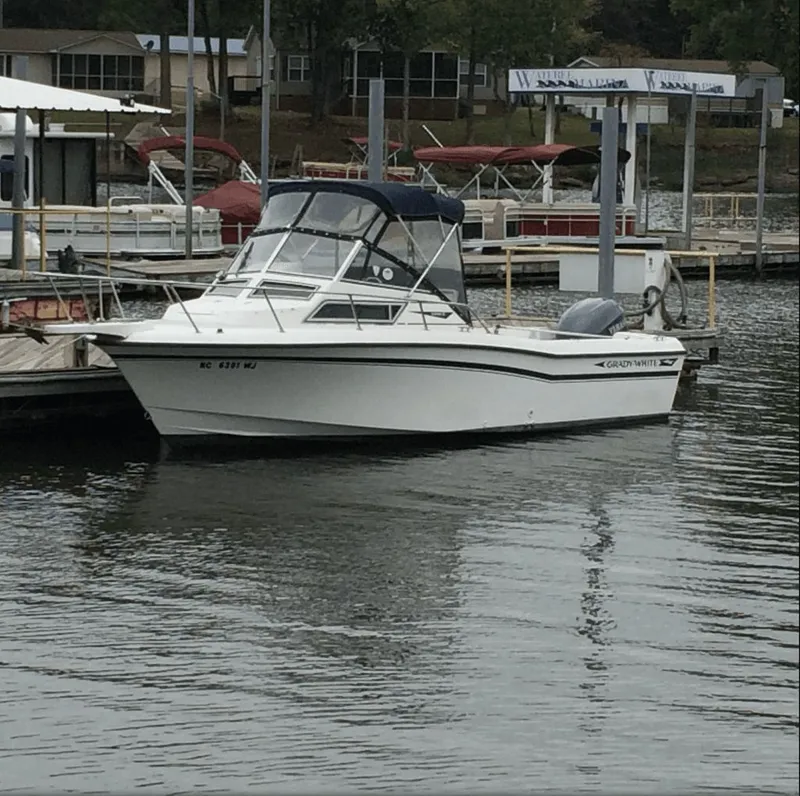
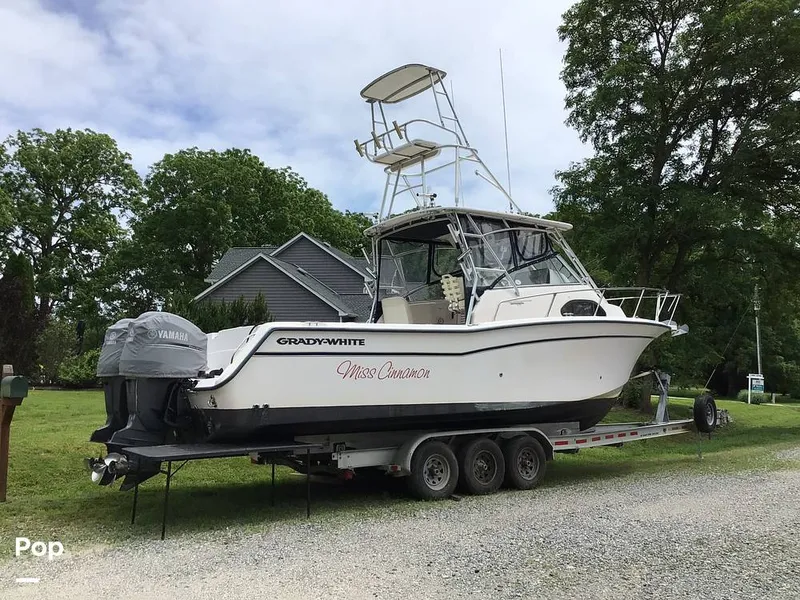
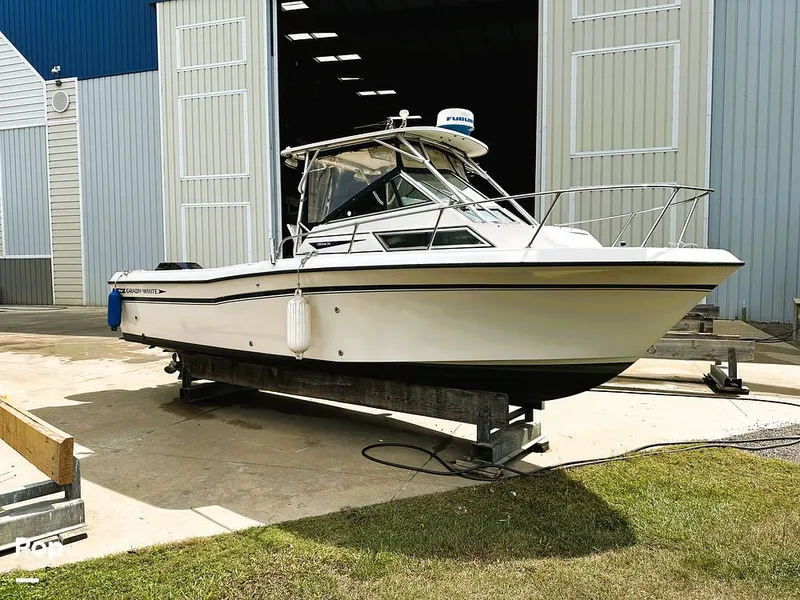
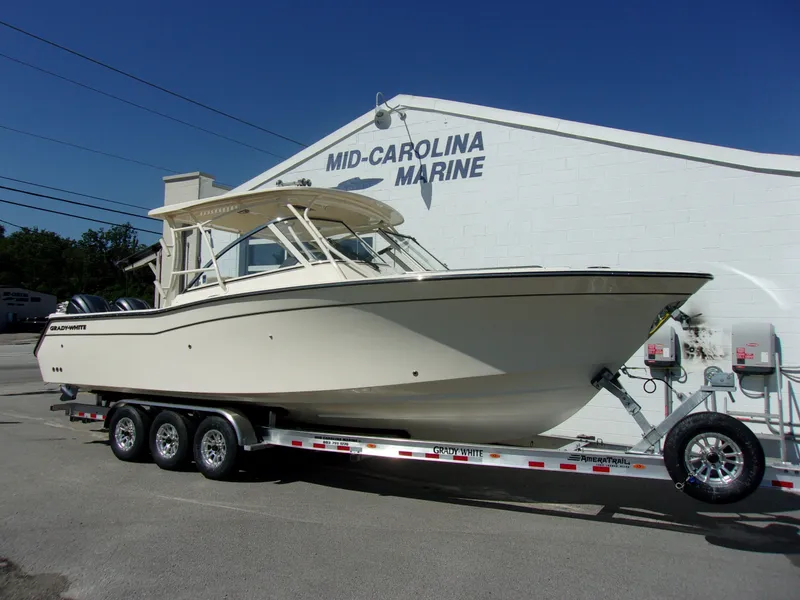
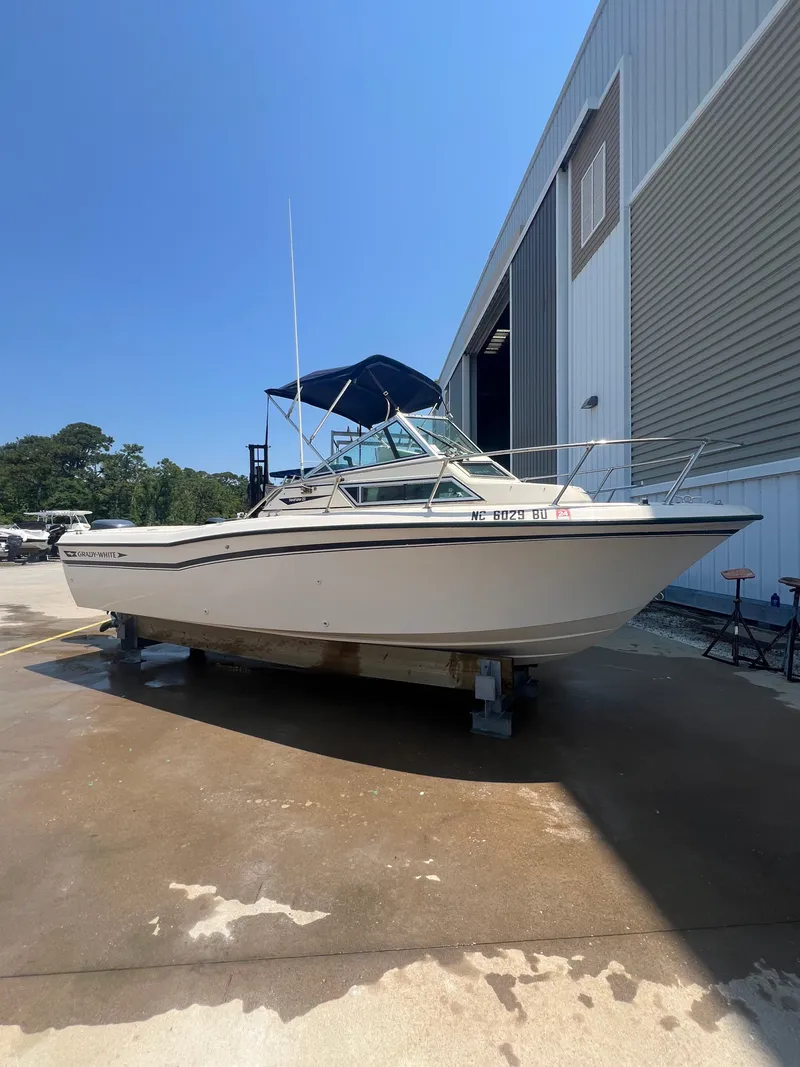
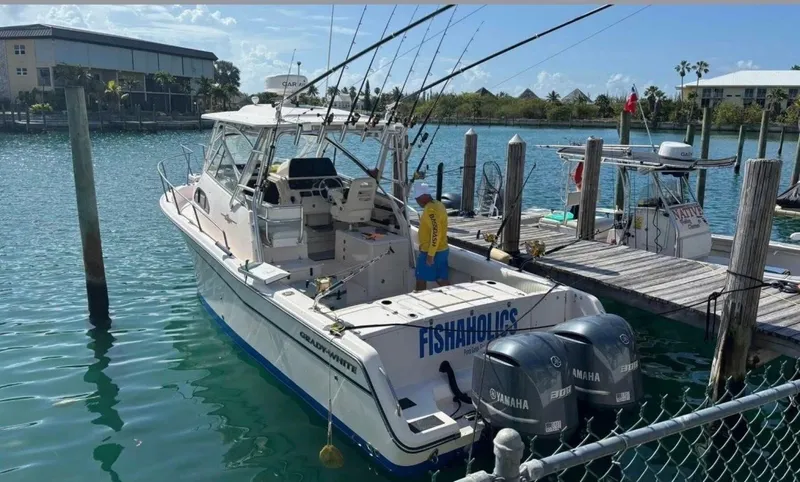
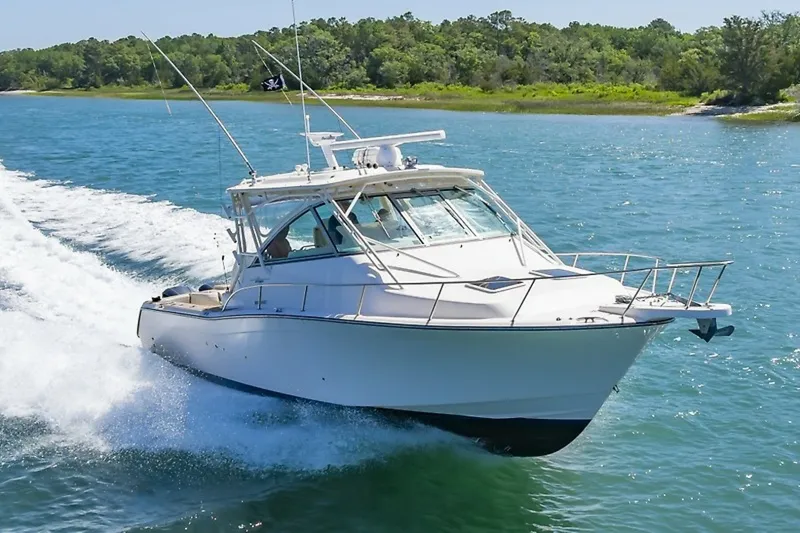
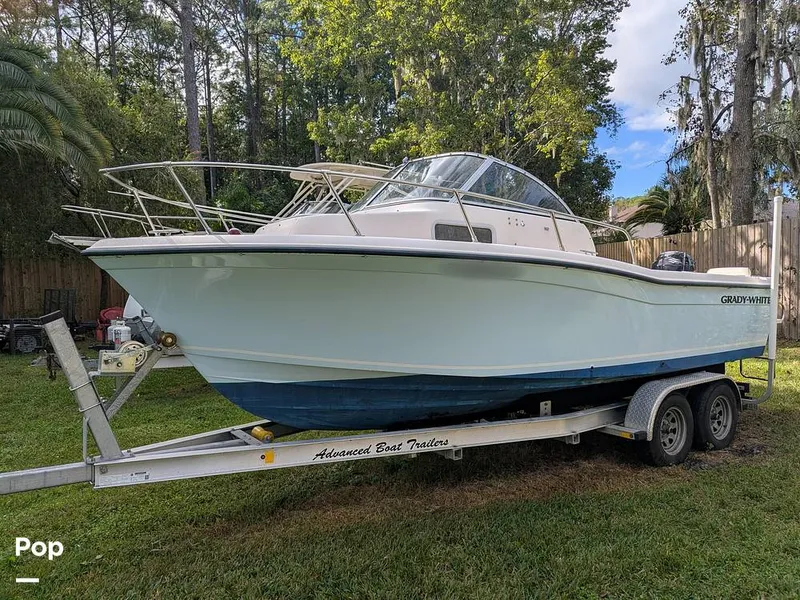
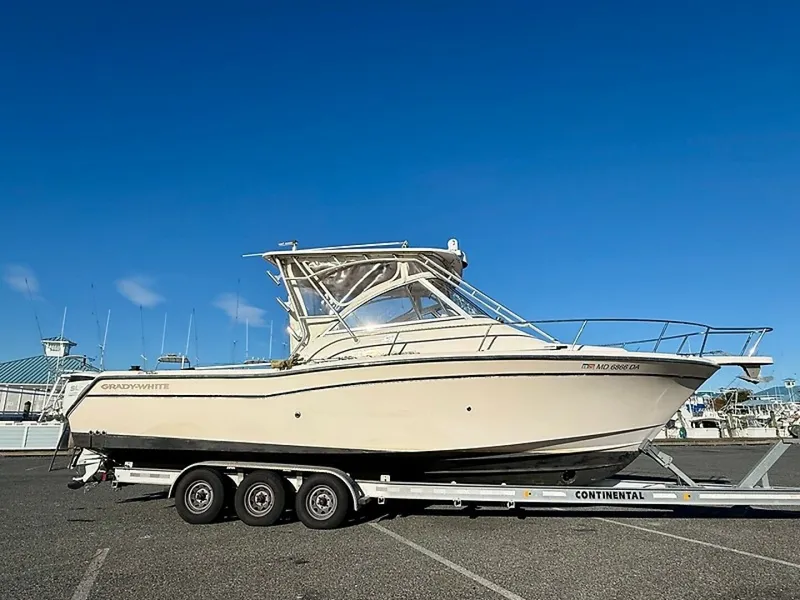
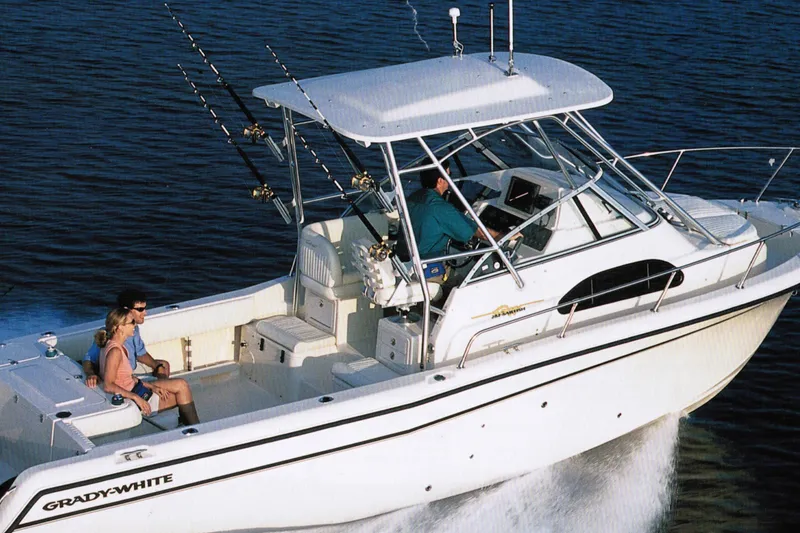
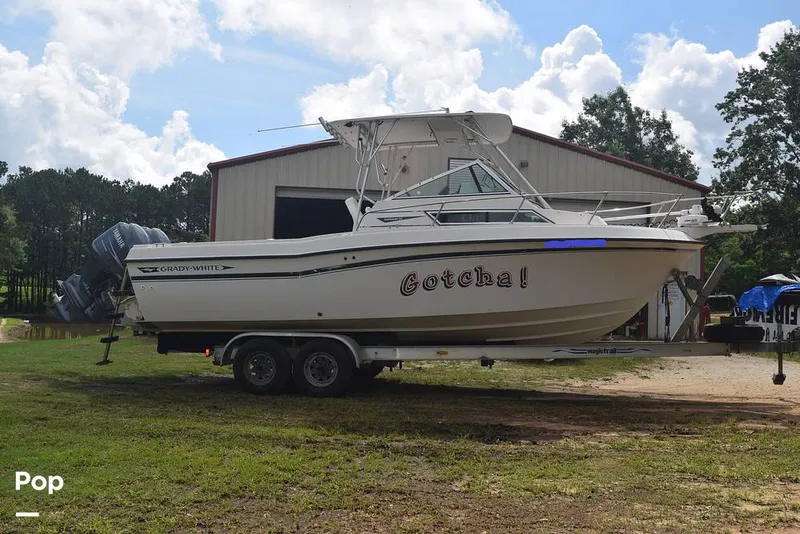
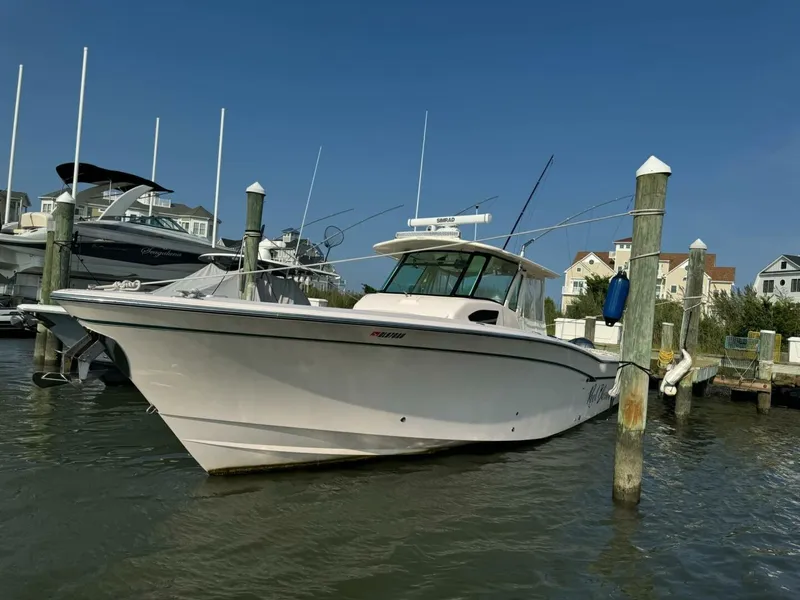
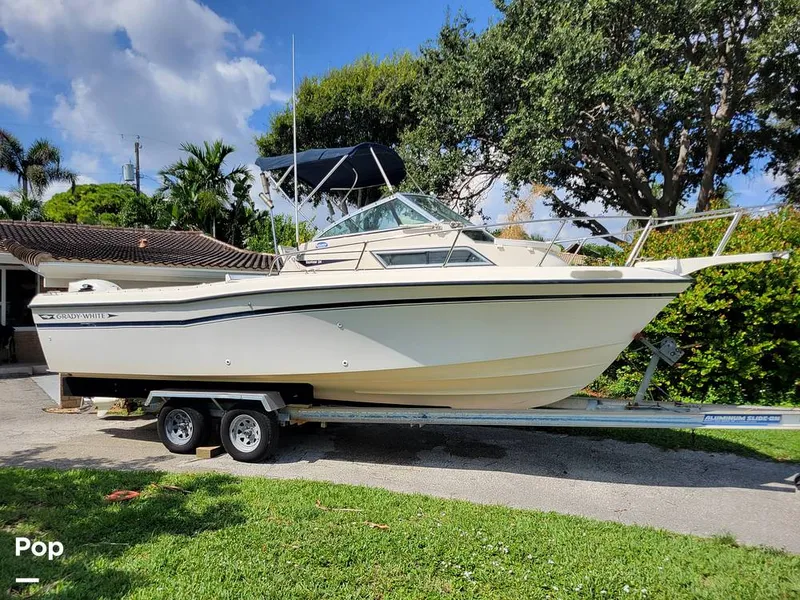
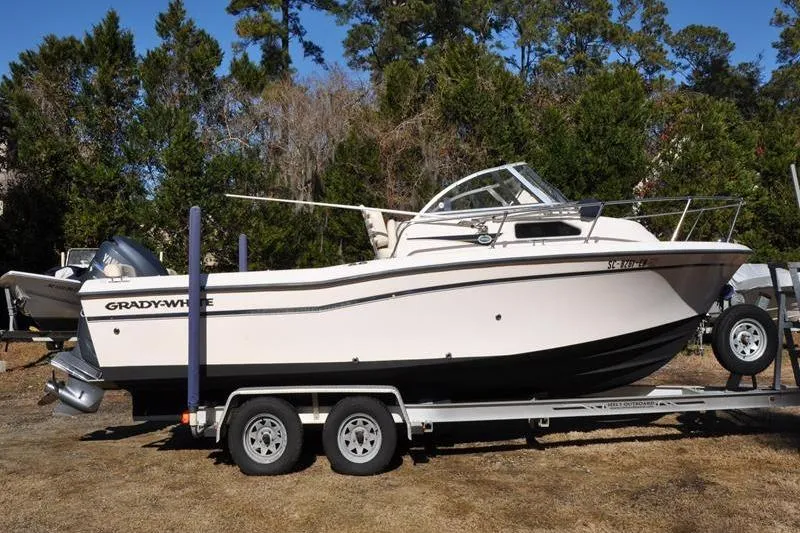
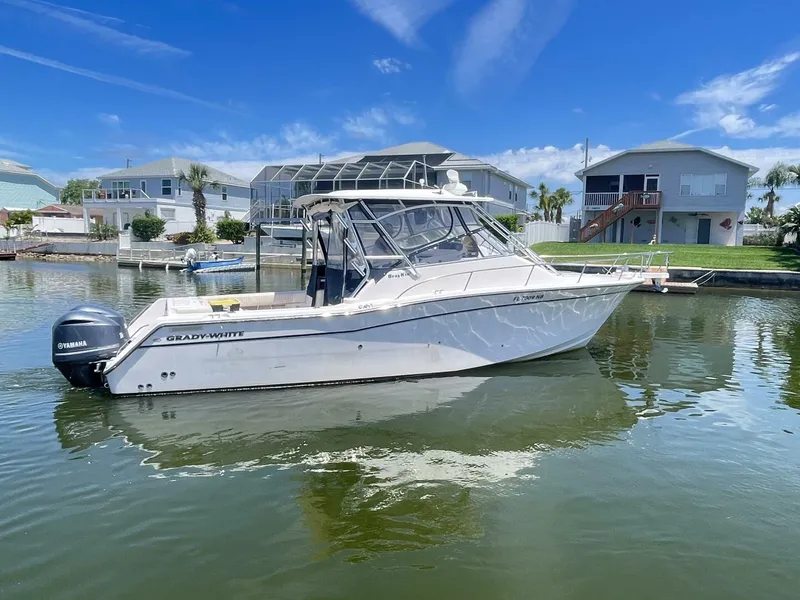
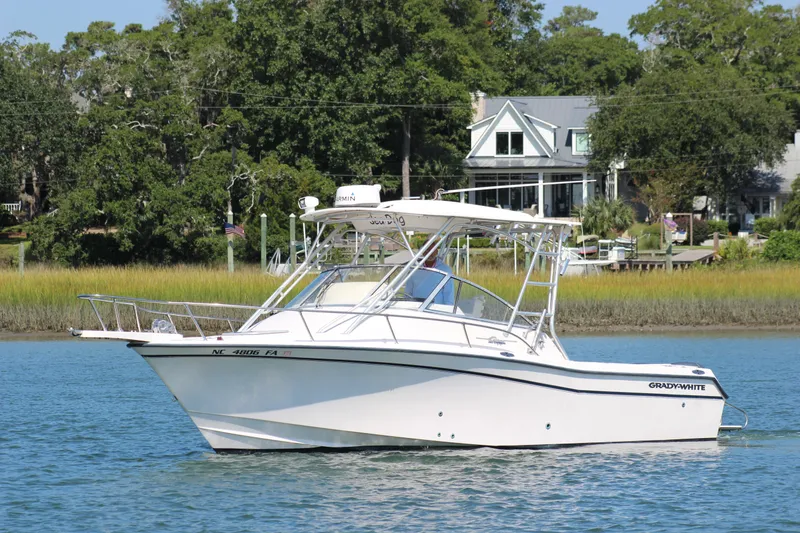
(Walkaround Cabins (Adventure & Marlin)) Grady-White's Walkaround Cabins, which the brand positions in the 21′ to 30′ size band, are represented by models such as the Adventure 218 at ≈23′3" with an 8′6" beam, a 16" draft and a 100 gal fuel tank sized for day trips, and the Marlin 300 at ≈30′6" centerline (approximately 30′ LOA) with a 10′7" beam, a 23" draft and a 282 gal fuel capacity supporting 700 HP propulsion. These walkaround designs pair a protected cabin and sheltered helm with the SeaV² continuously variable deadrise hull to provide a dry, confidence-inspiring ride in a compact footprint, and they are tailored for owners who want both fishability and the ability to cruise or overnight. Internal arrangements on these models commonly include berths and heads and offer storage and seating that make weekend cruising practical, while deck-focused elements preserve insulated fish boxes, livewells and generous rod storage for serious anglers. The walkaround plan keeps the cockpit accessible for fishing and easy to work while the cabin offers refuge from weather, which distinguishes these models from open-dayboat competitors that cannot match the overnight or all-weather capability. By combining outboard power with Grady-Whites saltwater-tough construction and flotation systems, the Adventure and Marlin walkarounds give buyers a versatile package for inshore excursions, family cruising and offshore days when shelter and fishability are both required.

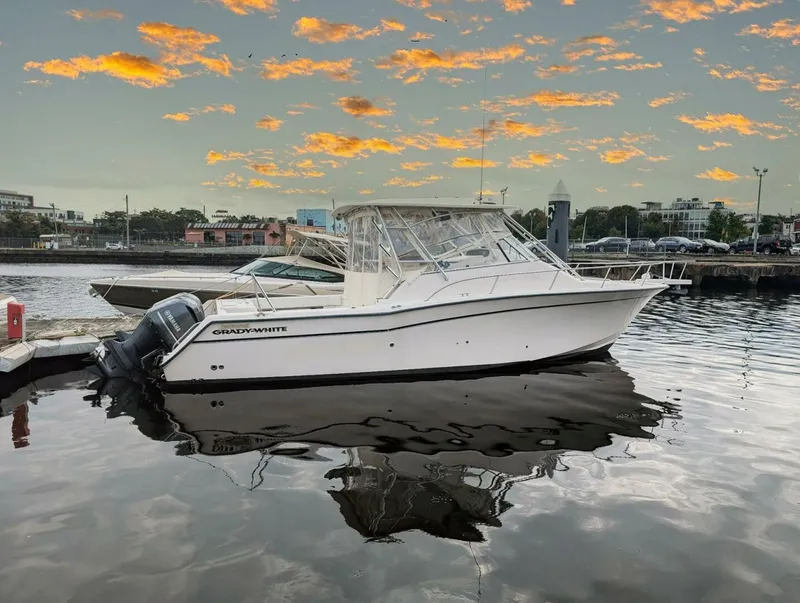
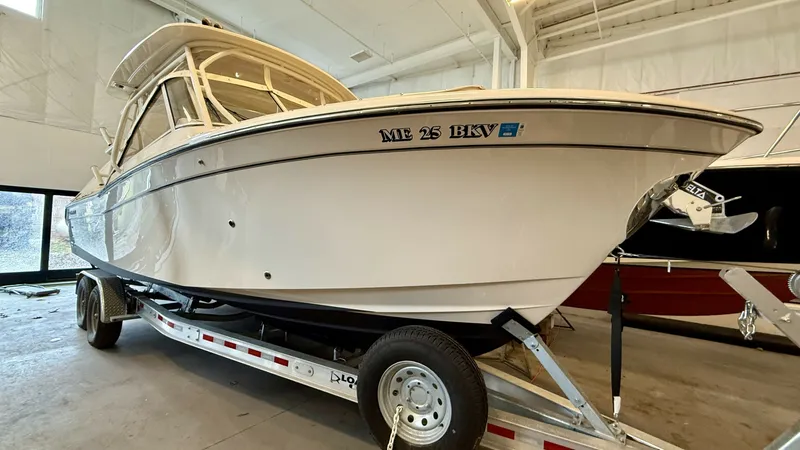
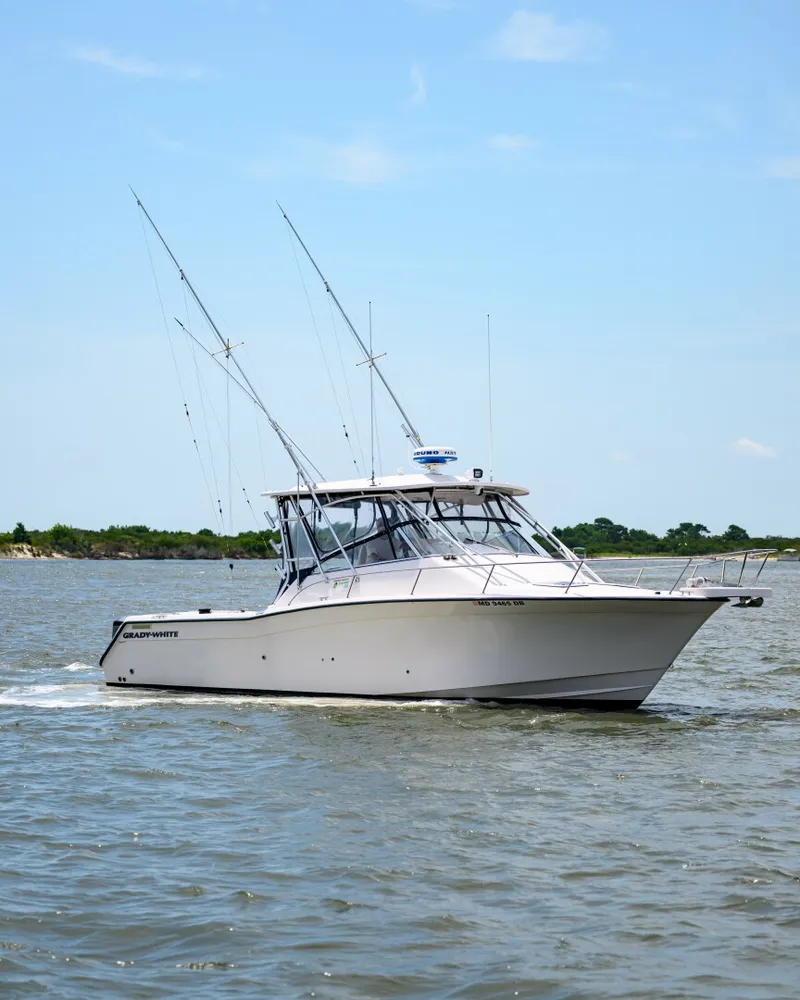
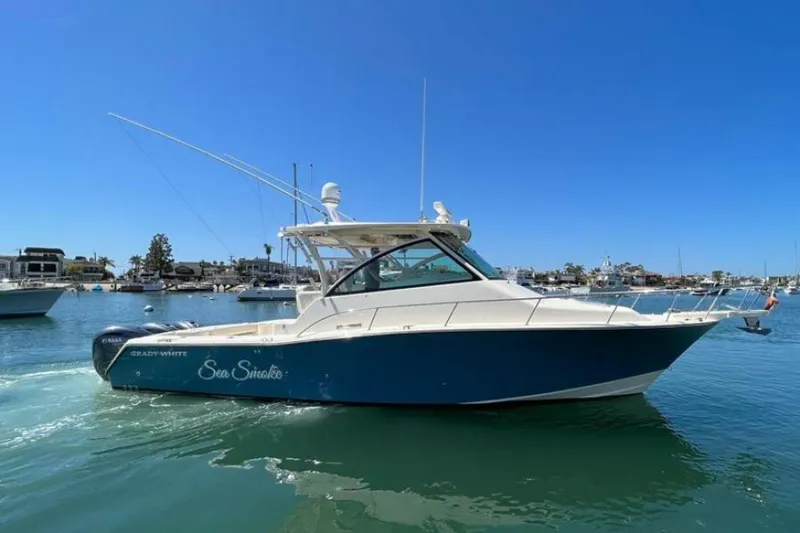
(Express Cabins) Grady-White Express Cabins occupy the 33′ to 37′ size envelope and are exemplified by the Express 340 at ≈34′ and the Express 370 at ≈37′ in the technical data. These express cabin models are engineered to serve serious offshore anglers and owners who require large cockpits for fishing as well as accommodations for overnighting, and they pair the SeaV² continuously variable deadrise hull with robust outboard propulsion to achieve seaworthiness and a dry ride in offshore conditions. Exact beam, draft and fuel figures are not provided in the supplied specifications for these two Express models, but the presence of substantial LOA and the brands emphasis on high-power outboard arrangements on larger models signal platforms capable of carrying significant fuel, gear and crew for extended trips. Accommodation-focused features on express cabins typically include enclosed sleeping spaces, heads and galley possibilities that support weekend cruising, while deck arrangements retain Grady-Whites fishing DNA through insulated fish boxes, livewells and abundant rod storage in order to preserve utility for anglers. Compared with more generic express offerings, Grady-Whites Express Cabins leverage the SeaV² hull, outboard-focused engineering and saltwater-tough construction to deliver a premium blend of offshore capability, fishability and liveaboard comfort that targets both tournament-minded buyers and families seeking capable offshore cruising.

HOW ARE THESE BOATS BUILT?

Grady-White boat construction begins with a proven hull and deck fabrication philosophy that prioritizes strength, repeatability, and long-term durability. Hulls are hand-laid in polished molds using a layered laminate schedule that starts with a high-solids catalyzed gelcoat sprayed into the mold and is followed by a 1.5-ounce knitted fiberglass mat to capture surface detail. That base is reinforced with bi-directional and tri-directional woven fiberglass fabrics and roving to create a uniform laminate. Resin is a temperature-controlled blended polyester system, metered for a strict resin-to-glass ratio during lamination to control weight and mechanical properties. For wider-beam models with beams greater than 8 feet 6 inches, end-grain balsa coring is used above the waterline to add stiffness with minimal weight penalty. The structural backbone uses a longitudinal fiberglass stringer grid and composite bulkheads, tabbed and bonded to the hull with hand-laid tabbing for load distribution; high-load hardpoints are further reinforced with composite inserts. Flotation is engineered using closed-cell foam in strategic compartments and sealed voids to meet buoyancy and safety requirements. Grady-White employs both open-molding hand-lay processes for primary hull laminates and closed-molding techniques such as resin transfer molding for smaller structural components and hardtops. Hull-to-deck joints are achieved through continuous fiberglass tabbing and adhesive bonding, with additional mechanical reinforcement at critical attachment points using 316-grade stainless fasteners. Throughout the lamination and assembly process Grady-White adheres to recognized marine industry standards, building in accordance with ABYC safety and wiring guidelines and meeting NMMA certification criteria where applicable.

Hardware and systems specification reflects marine-grade, corrosion-resistant choices: exterior fittings and deck hardware are typically 316-grade stainless steel, through-bolted or bonded to composite backing plates; engine mounts and boarding hardware are specified for rated shock loads. Electrical installations are executed to ABYC standards using tinned marine-grade copper conductors, sealed heat-shrink terminals, circuit protection and labeled distribution panels; plumbing uses marine-grade hoses and reinforced fittings with seawater-rated pumps and proper overboard discharge arrangements to meet sanitation and safety protocols. Upholstery and finish materials employ UV-stable marine vinyl, closed-cell high-density foam cores and composite or molded board backing with stainless fasteners for longevity in the marine environment. Manufacturing integrates modern engineering tools and precision fabrication technology including CAD/CAM for hull and systems design, CNC cutting for templates and core components, and automated resin metering, while preserving skilled hand-lay craftsmanship for lamination and finish work. Construction techniques therefore combine hand-laid laminates, controlled polyester resin infusion in defined areas and closed-mold RTM for select parts. Quality control is multi-tiered: dimensional checks against CAD models, resin-to-glass ratio monitoring, in-process inspections during lamination, tested electrical and plumbing circuits, dock and sea trials and final cosmetic inspections. Compared to industry norms, Grady-White emphasizes tighter process control, higher-grade stainless hardware and composite reinforcement strategies that exceed many standard hand-laid polyester builds. Boats are supported by Grady-White’s manufacturer limited warranty and dealer service network, reflecting a build philosophy that balances traditional craftsmanship with engineered repeatability to deliver safe, durable and long-lived vessels.

WHERE ARE THESE BOATS BUILT?

All Grady-White boats are built in the United States at Grady-White Boats, Inc.’s primary manufacturing facility located at 5121 Martin Luther King Jr. Highway in Greenville, North Carolina. The Greenville manufacturing complex is the company’s sole large-scale production site and is operated by Grady-White Boats, Inc.; it is reported as the dedicated facility for Grady-White production rather than a multi-brand plant. The plant footprint spans in excess of 500,000 square feet following successive investments, accommodating the production of 28 models ranging from roughly 18 to 45 feet, and the company has publicly noted that a recent expansion will create at least 65 new jobs, indicating a substantial workforce even though exact employee totals are not broadly disclosed. This U.S.-based facility serves as the parent-site for the brand’s manufacturing operations, handling the bulk of boat building and supporting Grady-White’s dealer network both domestically and for export markets.

Grady-White began manufacturing in Greenville when the company was founded in 1959 and has kept production in that region since inception; the business was acquired by Eddie Smith in 1968, a change in ownership that supported substantial growth and ongoing investment in the Greenville facility. Production is organized into specialized departments and production bays to manage the range of models the company builds, with dedicated areas for fiberglass lamination, systems integration and hull assembly as well as final finishing and outfitting; the facility is configured to accommodate different sized boats and model families so production flow can be adjusted between smaller 18-foot runabouts and larger center-console and express models up to 45 feet. On-site processes performed at the Greenville plant include fiberglass lamination work, hull and deck assembly, systems and electronics installation, and finishing and quality-control outfitting steps that together form the end-to-end manufacturing workflow. In 2025 Grady-White completed a plant expansion that added approximately 70,000 square feet to increase capacity and enable production of larger models such as the Canyon 456, and previous investments have grown the manufacturing footprint to more than a half-million square feet overall. The Greenville location provides geographic advantages for marine manufacturing, including proximity to the Atlantic coast and a regional skilled trades workforce, access to transportation infrastructure for distribution to domestic dealers and international export markets, and local economic incentives that have supported recent production investments and job growth in the region.

Grady-White's quality control and innovation program is concentrated at its single Greenville, North Carolina manufacturing campus and is woven into the facility's lamination, assembly and finishing departments, which together occupy more than 500,000 square feet and support production of 28 models ranging from 18 to 45 feet. The company's publicly available materials describe systematic inspections at key production stages and documented in-house testing protocols that target hull and structural integrity, systems integration and consistent fit-and-finish across hull sizes; while specific ISO or other formal certifications are not listed in the disclosed information, Grady-White emphasizes adherence to industry-standard manufacturing practices, regulatory requirements and supplier qualification processes supported by centralized quality records. Materials sourcing is a mix of local and imported components, and the centralized production footprint makes it possible to standardize process controls, share tooling and skilled trades across model lines and accelerate iterative innovations—cross-utilization of molds, jigs and production cells has enabled efficient ramping of larger models such as the Canyon 456 introduced following the 2025 plant expansion that added over 70,000 square feet. Continuous improvement investments, including the 2025 equipment modernization and expanded production bays, are implemented facility-wide so that engineering changes, lessons learned and supplier quality feedback benefit every model in the line, reducing rework and improving first-time pass rates on final inspections while supporting export-ready documentation for dealers across North America, Europe, Asia, South America and Australia. This single-site approach to manufacturing, testing and innovation preserves consistency in how every Grady-White boat is built and allows the company to maintain tight control over production throughput, quality metrics and delivery schedules.

All Grady-White boats are built at the Greenville production facility located at 5121 Martin Luther King Jr. Highway, Greenville, NC 27834, and the company's domestic manufacturing identity was reinforced by the 2025 expansion and local incentives including support from North Carolina's Rural Economic Development Grant program. That expansion, which increased the plant footprint by more than 70,000 square feet and is expected to create at least 65 new jobs, complements a skilled workforce and a manufacturing legacy that dates back to the company's 1959 founding. Grady-White remains committed to building premium offshore and family fishing boats at its Greenville facility and to continual investment in the people, processes and production infrastructure that support consistent quality and global distribution to North America, South America, Europe, Asia and Australia, while leveraging Greenville's proximity to the Atlantic Ocean and major transportation hubs to serve its international dealer network.
WHAT IS THE BIGGEST BOAT OF THIS BRAND BUILT TODAY?

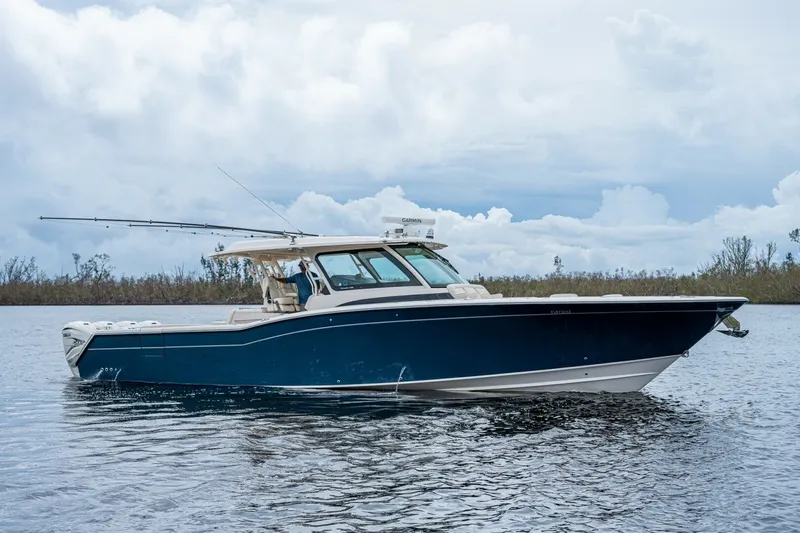
The Canyon 456 is Grady-White’s flagship and the biggest boat built by Grady-White today, introduced as a 45-foot center console sportfishing yacht with a Length Overall of 45 feet (13.72 meters), a beam of 14 feet (4.27 meters), draft of 30 inches (0.76 meters) and bridge clearance of 10 feet 5 inches (3.18 meters); displacement is listed at 24,500 pounds (11,113 kilograms) without engines and fuel capacity is 616 gallons (2,332 liters) with a 70-gallon (265 liter) livewell, 80 gallons (303 liters) of fresh water and a 30-gallon (114 liter) diesel tank. The Canyon 456 is configured as a quad-outboard center console, typically equipped with four Yamaha 450 XTO Offshore outboard engines for a combined 1,800 horsepower maximum; official top speed can exceed 55 MPH depending on load and conditions. The hull utilizes the C. Raymond Hunt Associates designed SeaV² hull form, emphasizing heavy-displacement center-console stability and Grady-White’s focus on offshore capability and seaworthiness for serious sportfishing and cruising.
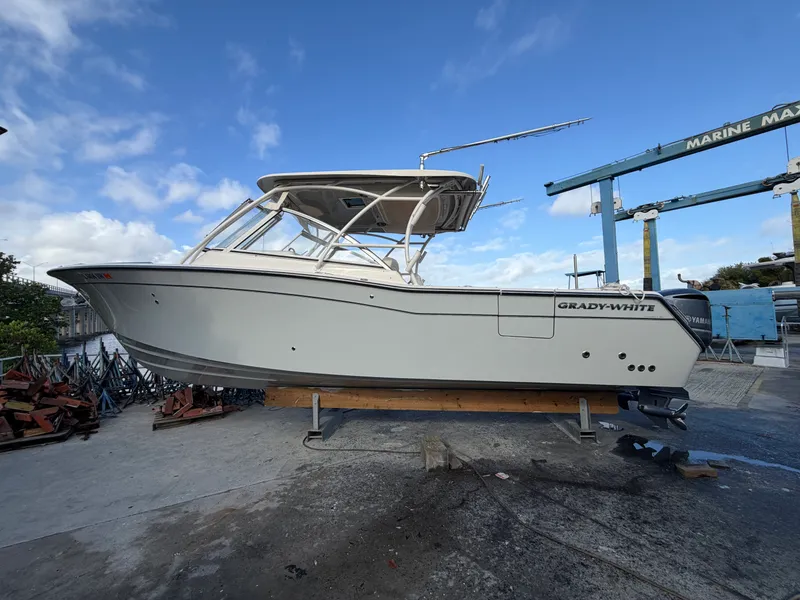
As the largest Grady-White model, the Canyon 456 is positioned for offshore sportfishing and extended cruising, aimed at serious anglers and boating enthusiasts seeking a luxury center console experience; the factory materials note that the model is designed for both fishing and cruising with ample space and comfort and highlights Grady-White’s exceptional attention to detail and craftsmanship. Specified fishing amenities include a 70-gallon livewell and large fuel and water capacities to support long days offshore, while the "Sea Command Center" helm includes four electrically adjustable seats and extensive electronics space. The cabin below console features a convertible dinette, enclosed head with shower, and galley, providing a level of luxury rare in center consoles. As Grady-White’s flagship, the Canyon 456 stakes the brand into the 45-foot luxury sportfishing market.

WHAT IS THE SMALLEST BOAT OF THIS BRAND BUILT TODAY?

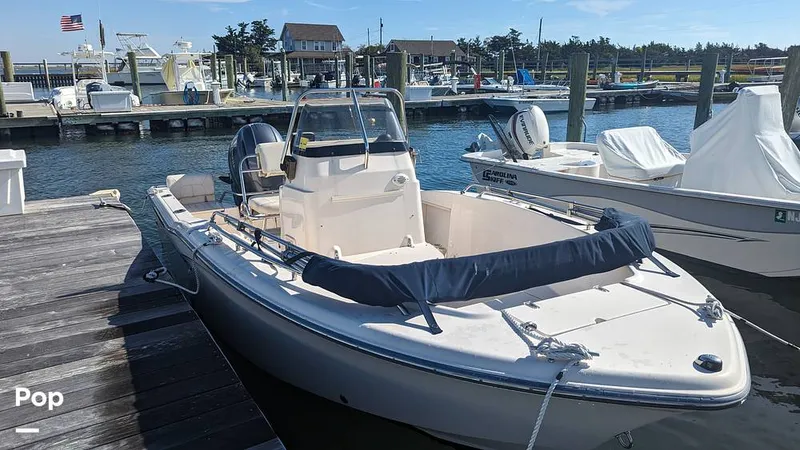
The smallest model in Grady-White's current lineup is the Fisherman 180, an 18 feet 3 inches (5.56 meters) overall length vessel with a 7 feet 6 inches (2.29 meters) beam and a dry weight of approximately 2,000 pounds (907 kg), featuring an approximate 12 inch (0.30 meter) draft and trailering requirements that call for a standard vehicle with at least a 2,500 pound towing capacity; positioned as an entry-level fishing and family boat, the Fisherman 180 brings practical benefits for new and experienced boaters, including easy trailering and ramp launching thanks to its light weight and compact dimensions, suitability for standard residential storage and slips, simple helm controls, self-bailing cockpit, ample rod and gear storage, and the straightforward upgrade path into larger Grady-White models.

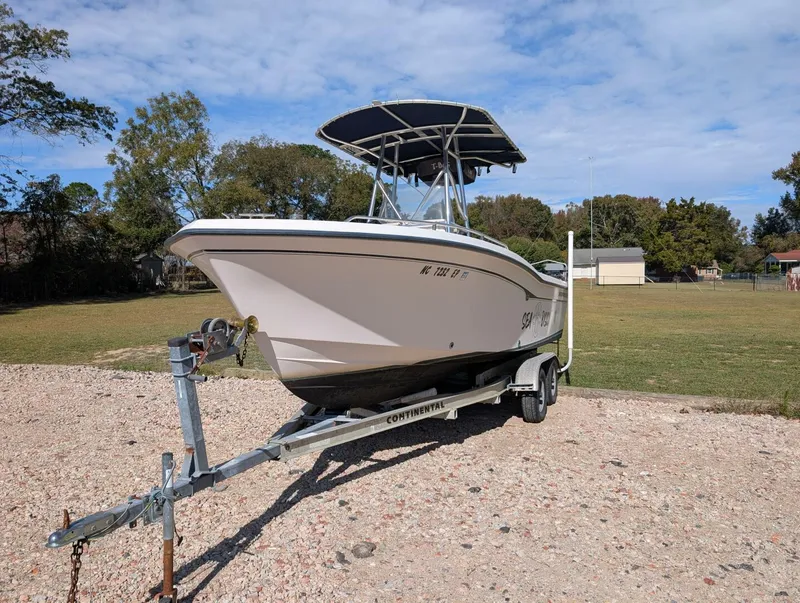
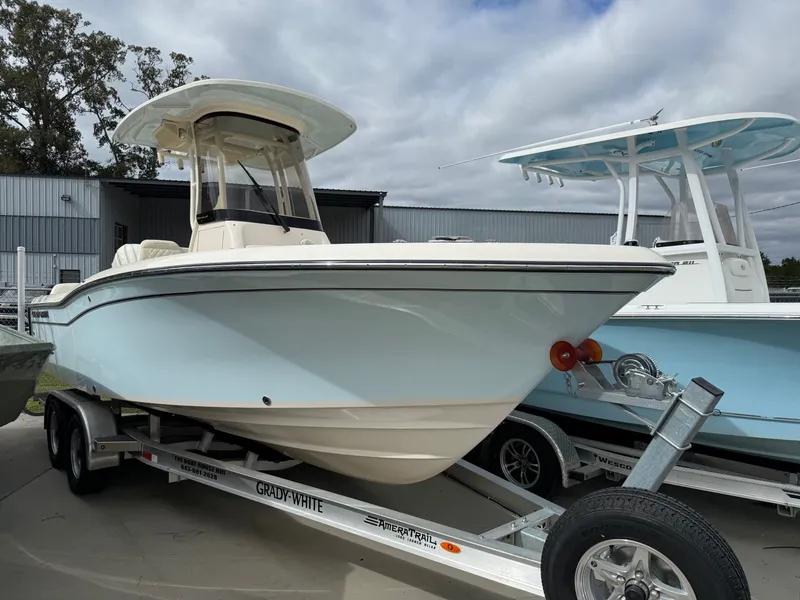
The Fisherman 180 is a compact, center-console style fishing boat from Grady-White that packs a simple, practical layout into an 18 foot 3 inch hull; Grady-White's smallest offering today features a straightforward helm with room for a leaning post or bench, bow and cockpit seating for up to six passengers, comfortable for family outings, and the specific USCG-rated capacity is not provided here. Construction follows Grady-White's reputation for solid build quality with a self-bailing cockpit, insulated fish boxes, ample rod storage and multiple dry storage compartments that keep gear secure, while its lightweight 2,000 pound dry weight and trailer-friendly dimensions make it easy to tow and store. The Fisherman 180 is designed for outboard power and typically pairs with Yamaha engines from 115 to 150 horsepower with a 150 hp maximum option; speed and fuel efficiency will vary by engine choice and load but the model is optimized for efficient inshore performance. Fishing features include insulated fish boxes, rod storage and optional livewell and T-top for shade; the layout also supports casual family outings and watersports, positioning the Fisherman 180 as an entry-level Grady-White or the smallest Grady-White ideal for first-time owners and budget-conscious anglers who want a compact, capable platform with sensible storage and easy operation.
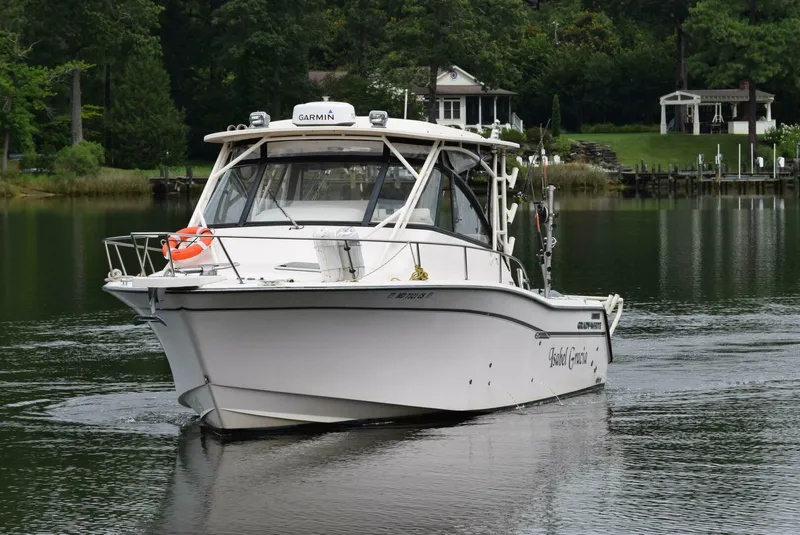
HOW MUCH DO THESE BOATS COST?

Grady-White sits in the premium recreational boat segment with a broad lineup that spans center consoles, dual consoles, express cabins and walkaround models; the official Grady-White website lists full specifications for each hull but does not publish MSRP, directing buyers to contact local dealers for exact new pricing. The smallest model shown on Grady-White's site is the Freedom 205, a compact walkaround/center-console style boat listed by the manufacturer with detailed specifications (approximately 20 feet in length overall and a trailerable footprint) on the official model pages; because Grady-White does not post MSRP on its public site, there is no single factory sticker price available to quote here. In the current market the entry-level and older Grady-White boats trade well: current market listings typically range from about $14,774 for older, small models up through roughly $89,000 for older mid-size examples such as older Marlin 300 models, with condition, equipment and year driving where a specific Freedom 205 or similar model will fall in that range. The difference between an unpublished MSRP and actual market price is notable for Grady-White boats because dealer markups, regional demand and used-boat condition play a large role in asking prices.
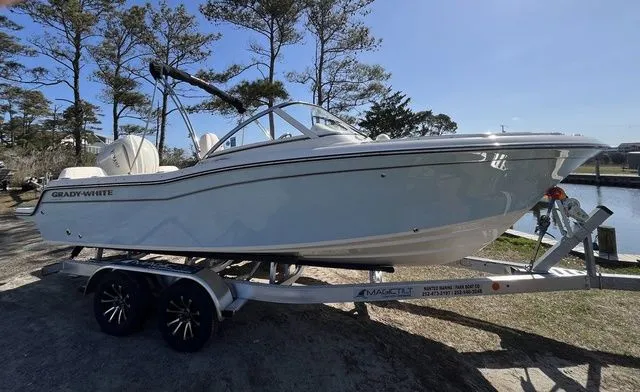
For mid-range and the brand's most popular models, Grady-White owners and buyers focus on boats like the Express 330, Canyon 376 and Freedom 335; again the manufacturer does not publish MSRP figures on the public site, so official base pricing must be obtained from an authorized Grady-White dealer, but third-party marketplace research shows clear market-price patterns. For example, a 2021 Grady-White Express 330 was observed at an asking price of $464,900 and other mid-size and larger Grady-White models in recent listings span wide ranges: many pre-owned Express, Canyon and larger coastal-explorer variants are currently listed between the low six-figure range and several hundred thousand dollars depending on year and factory and aftermarket options, and the pre-owned market includes extreme high-end examples that exceed $1.7 million for newer, heavily equipped yachts. New-unit pricing trends are therefore best treated as dealer-quoted MSRP adjustments rather than fixed online numbers; Market prices vary by location, condition, model year, and dealer. For the most accurate comparison between MSRP and market price for any Grady-White model, contact an authorized dealer and compare recent pre-owned asking-price ranges for the specific model and year you are considering.
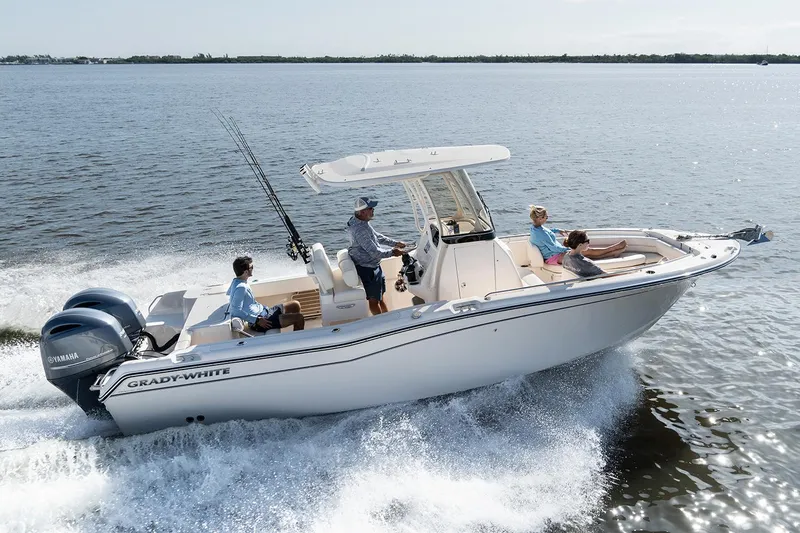
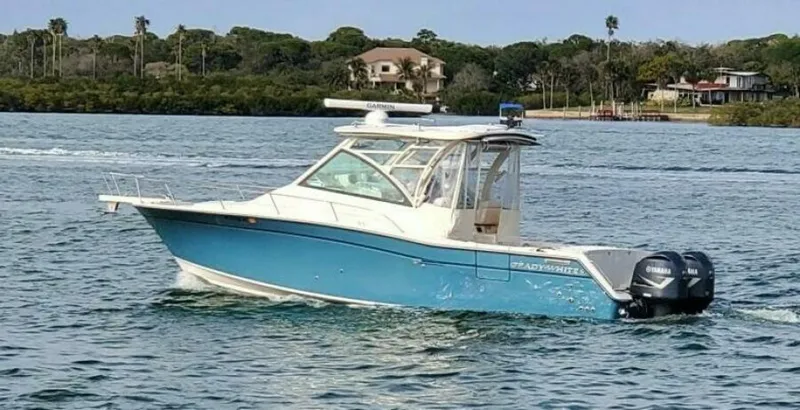
Grady-White’s flagship and premium models are described on the official Grady-White website by layout and capability rather than by listed MSRP, so official specifications (hull types, cabin vs center-console arrangements, standard equipment and factory options) are the primary published details buyers can confirm online. Models such as the Express 330 (express-cabin), Freedom 335 (center-console) and Marlin 300 (walkaround/dual-console family) are presented with factory option packages, engine configurations and construction specs on the manufacturer site, but Grady-White does not publish a public MSRP and directs buyers to local dealers for pricing. In the resale marketplace, premium Grady-White models generally command substantially more than base expectations; current market listings show well-equipped Express 330 and Freedom 335 examples typically priced in the mid-to-high six-figure band, while newer flagship or custom-equipped boats can be listed for well over one million dollars. For example, a recent market listing for a 2021 Express 330 was offered around $464,900, and upper-tier, newer models appear among listings exceeding $1,000,000 into the $1.7 million plus territory. Options, engine hours, service history and model year materially affect market price so that a fully optioned, low-hours example can sell for significantly above the factory base configuration while older or higher-hours boats trade at meaningful discounts to that base expectation.

Summarizing pricing across Grady-White, MSRP is not posted on the manufacturer site so buyers should treat factory 'base' pricing as dealer-quoted rather than publicly listed, while the observed market price spectrum on resale platforms ranges from roughly $14,774 for older, entry-level models to more than $1.7 million for newer, highly equipped vessels; typical asking prices for well-maintained mid-size models commonly fall between roughly $80,000 and $600,000 based on model year and condition. Buyers should also budget for additional costs commonly noted in dealer discussions—freight, dealer prep and rigging, registration and taxes, optional electronics and factory-installed upgrades—all of which increase delivered price beyond any base MSRP or quoted market price. Market prices vary by location, condition, model year, and dealer. In practice Grady-White boats often retain value well relative to peers, but real-world selling prices frequently deviate from dealer quotes: new-boat out-the-door costs will include dealer fees and local taxes, while actual resale listings reflect supply, localized demand and the specific boat's equipment and hours.

WHAT OTHER STYLES OF BOATS DO THEY MAKE?

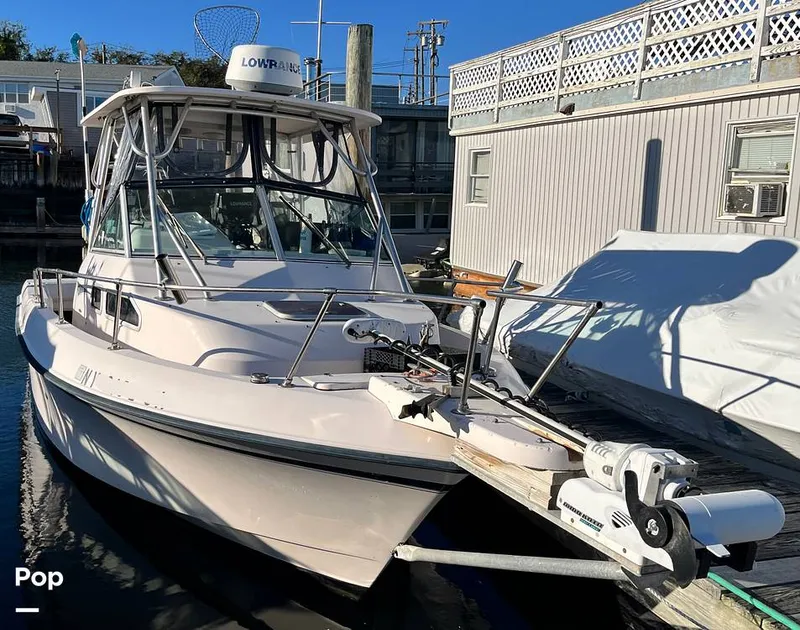
Grady-White currently produces center console, dual console, walkaround cuddy cabin, express cabin and Coastal Explorer styles, with the Canyon center console series and Freedom dual console series among the most popular and iconic in their lineup; the Canyon boats are built for offshore fishing and serious anglers while the Freedom dual consoles are aimed at family boating and watersports, and smaller Fisherman center consoles like the Fisherman 180 through 257 serve anglers seeking trailer-friendly, highly maneuverable fishing boats. Walkaround cuddy cabins such as the Adventure 218 and Marlin 300 and express cabins like the Express 340 and Express 370 provide overnight capability for family cruising and longer trips, while Coastal Explorer models such as the 231 CE, 251 CE and 281 CE are tailored to inshore and shallow water work. Across the range Grady-White emphasizes outboard power, SeaV² hull performance for a dry, stable ride, premium hull construction, fishing boat features like live wells and rod storage and family boat comforts in seating and entertainment, creating versatile, performance-oriented designs suitable for fishing, cruising, watersports and entertaining.

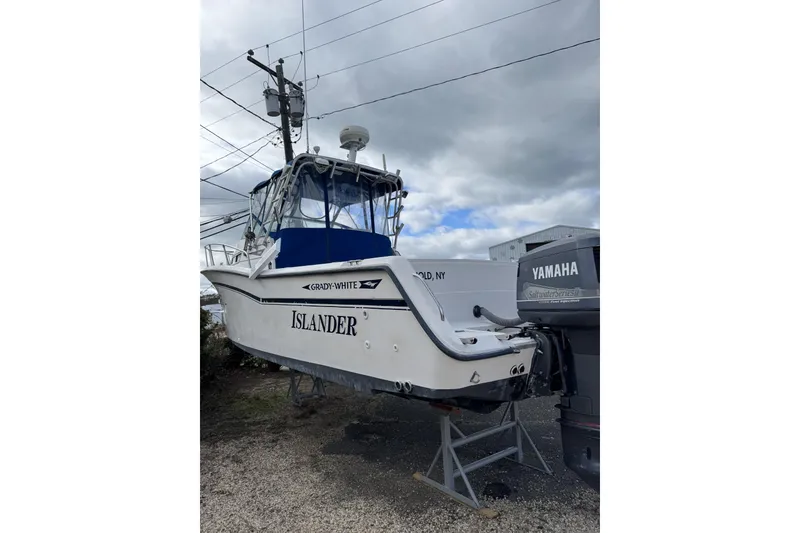
Over its history Grady-White has also built other notable styles and previous model iterations that contributed to the companys heritage and that remain common on the used market, including earlier express cabin and cuddy designs and prior center console generations; the Express 330 is an example of a previous model that evolved into the current Express 340, and older walkaround and cuddy layouts historically offered true overnight cabins and generous storage that appealed to cruising anglers. Earlier iterations of the Canyon and Freedom lines illustrate how Grady-White refined offshore and dual console concepts over time, and past models stood out for twin-engine options in some cases, spacious cabin arrangements, and purpose-built fishing appointments, so buyers looking in the preowned market will find a range of legacy Grady-White boats from compact Fisherman walkarounds to larger express cabin and offshore models that helped define the brand.

Grady-White does not compete in certain segments such as pontoon boats, traditional deck boats, large luxury yachts, dedicated ski and wake boats, or purpose-built electric or hybrid models, and they do not offer tenders or auxiliary boats as a primary product line; instead Grady-White concentrates on outboard-powered center consoles, dual consoles, walkaround and express cabin designs and Coastal Explorer inshore models, which keeps their lineup tightly aligned with saltwater toughness and fishing-first layouts; the company's focus shows in models like the Fisherman 180, Fisherman 216, Fisherman 236 and Fisherman 257 and the Canyon 271 through Canyon 456 for offshore center console performance, the Freedom 215 through Freedom 415 dual console series for family-friendly versatility and watersports-ready decks, and the Adventure 218 and Marlin 300 walkaround cuddy cabins plus the Express 340 and Express 370 for overnight-capable express performance, and that emphasis on SeaV² hulls, ample rod storage, dedicated live wells and secure deck layouts confirms Grady-White's identity as a builder of seaworthy, angler-oriented boats rather than lifestyle pontoon or wake-focused brands.

Summing up, Grady-White is best known for center console fishing boats such as the Fisherman and Canyon series, family-oriented dual console Freedom models, walkaround and cuddy cabin Adventure and Marlin boats, express cabin Express 340 and Express 370 models and the shallow-water Coastal Explorer 231 CE, 251 CE and 281 CE, and the brand's reputation rests on build quality, offshore-capable SeaV² hull performance and layouts that balance fishing functionality with family-boat comfort; recent moves such as the reimagined Express 340 and the innovative Freedom layouts hint at continued evolution toward crossover and hybrid layouts within their existing categories rather than a broad move into pontoon, wake or large-yacht segments, and that focused strategy helps Grady-White refine the center console, dual console, walkaround and express styles that define the brand while keeping the core angling and family boating customer central to design decisions.

WHAT KINDS OF ENGINES DO THESE BOATS USE?

Grady-White boats are predominantly powered by outboard engines, a design choice that supports shallow-draft operation, easier maintenance and servicing, and generally better corrosion resistance for saltwater use; while the brand does make use of inboard propulsion on a limited number of purpose-specific models, the majority of the lineup is optimized around four-stroke outboard power from Yamaha, which provides proven reliability and wide dealer support. Across the lineup you will find single-engine installations on the smallest walkaround and bay models, twin outboards on most mid-size center consoles and dual-console boats, and triple outboards on the larger offshore express and convertible models where redundancy, acceleration and higher top-end horsepower are priorities; Grady-White typically pairs these outboards with modern engine management and digital controls, including Yamaha digital throttle and shift systems, and in many models offers joystick steering or optional joystick control packages for close-quarters maneuvering. Standard versus optional propulsion is usually fixed by model but dealers and factory options allow selection of different Yamaha engine ratings within a mounting configuration, so a given hull might be sold new with a choice of Yamaha four-stroke outboard ratings, digital controls and propeller packages to tune for fuel efficiency or top speed. Grady-White’s close relationship with Yamaha means most published specs reference Yamaha engines including the high-horsepower Yamaha XTO Offshore units on flagship models, and maintenance schedules, warranty coordination and electronic integration are all developed with those engine platforms in mind.

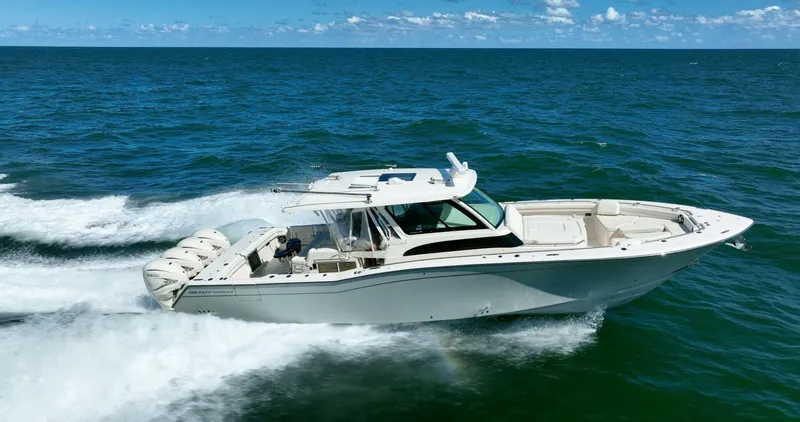
Horsepower across Grady-White’s models scales predictably with size and intended use: smaller models such as the Fisherman 180 are offered with a single outboard up to about 150 horsepower, suitable for day-cruising and inshore fishing with efficient fuel consumption at modest cruise speeds; mid-size models like the Gulfstream 232 are commonly configured with twin outboards—examples include dual 150 HP or dual 200 HP Yamaha four-stroke engines—delivering stronger cruising performance and better load-carrying capacity. On larger offshore models Grady-White moves to twin or triple outboards to reach higher combined horsepower figures and top speeds: the Canyon 336 can be specified with twin 450 HP Yamaha XTO Offshore engines or a triple 350 HP Yamaha four-stroke arrangement depending on priority for top speed versus weight distribution, and the Freedom 375 and Express 370 are factory-rated to accept triple 450 HP Yamaha XTO Offshore engines. Published factory performance shows the Freedom 375 with triple 450 HP engines achieving a top speed around 57.4 MPH at 5,900 RPM with an optimum cruise near 30.4 MPH at 3,400 RPM burning roughly 32.9 GPH (about 0.92 MPG), the Express 370 with triple 450s reaching about 58.4 MPH top speed and an optimum cruise near 29.8 MPH at 3,400 RPM consuming about 32.5 GPH (roughly 0.9 MPG), and the Canyon 336 twin-450 setup cruising near 29.0 MPH at 3,500 RPM at about 22.6 GPH (around 1.28 MPG).

Grady-White boats are predominantly fitted with outboard engines across their lineup, with inboard power used on select models where the design calls for it, offering single, twin and triple engine configurations to match vessel size and purpose. Smaller models like the Fisherman 180 come standard with a single outboard (up to 150 horsepower), mid-size models such as the Gulfstream 232 are commonly rigged as twin outboards (examples include dual 200 HP Yamaha four-stroke engines or dual 150 HP Yamaha four-stroke options), and larger center-consoles and express models like the Freedom 375 and Express 370 are factory-configured with triple outboards, typically specified with triple 450 HP Yamaha XTO Offshore engines to deliver the horsepower and redundancy demanded by offshore performance. The Canyon 336 demonstrates the line's flexibility with either twin 450 HP Yamaha XTO Offshore or triple 350 HP Yamaha four-stroke outboard packages depending on owner preference. Yamaha is the brand's primary engine partner and a long established supplier for factory propulsion, and Grady-White's boats are built around four-stroke outboard technology including Yamaha's high-horsepower XTO Offshore line. Factory packages generally include the recommended engine choice, controls and rigging so the propulsion, digital controls and steering systems are integrated at the factory level; authorized dealers can advise on repower and alternative rigging options but published model specifications focus on Yamaha four-stroke outboards.

Grady-White pairs its hull designs with modern engine technology to deliver usable performance, drivability and efficiency for anglers and families; common features include Yamaha digital throttle and shift digital controls that provide crisp shifts and synchronized throttling on twin and triple outboards, and joystick steering systems available on many multi-engine models for intuitive low-speed maneuvering and easier docking. High-horsepower Yamaha XTO Offshore outboards in triple 450 HP configurations give punchy hole-shot and top-end speeds; for example, factory performance data show the Freedom 375 with triple 450 HP Yamaha XTO Offshore engines reaching about 57.4 miles per hour at 5,900 RPM and an optimum cruise near 30.4 MPH at 3,400 RPM consuming roughly 32.9 GPH for about 0.92 MPG, while the Express 370 with the same triple 450 HP package reaches 58.4 MPH top speed and cruises near 29.8 MPH at 3,400 RPM using about 32.5 GPH for 0.9 MPG; the Canyon 336 twin 450 HP XTO package cruises around 29.0 MPH at 3,500 RPM while burning about 22.6 GPH for roughly 1.28 MPG. These figures underline how performance hulls and four-stroke outboard power are tuned for fuel efficiency and handling. Practical boater benefits include shallow-water access and easier maintenance provided by outboards, the availability of tilt-up motors for trailering or beaching, and generally lower in-service maintenance compared with comparable inboard drivetrains, while factory-integrated controls and rigging simplify ownership. Overall Grady-White's engine strategy of factory-specified Yamaha four-stroke outboards and modern digital controls aligns with the brand's mission to offer dependable, high-performance, easy-to-operate boats for serious recreational and offshore use.

WHY BUY THIS BRAND OVER A COMPETITIVE BRAND?

Grady-White's construction centers on its exclusive SeaV2® hull, a continuously variable vee hull whose deadrise increases from under 20 degrees at the transom to over 50 degrees at the bow; the SeaV2 uses two strakes and a pronounced chine to cut through water, generate lift and stability, and deliver a soft, dry, and stable ride that the company highlights as providing offshore confidence and superior handling in rough conditions. The SeaV2 hull was introduced in 1989 and Grady-White notes its long track record and recognition in multiple J.D. Power and Associates Marine Studies where Grady-White ranked number one in each of the eight studies cited, reinforcing customer satisfaction with Grady-White and the build quality of Grady-White boats. Structural and safety features documented by the manufacturer further the brand's claims of durability and seaworthiness, including unsinkable foam flotation, self-bailing cockpits, overboard draining fish boxes and 316 grade stainless steel bow rails, all specified in Grady-White owner literature and product descriptions to support long term durability and practical safety at sea.

When buyers ask 'Why choose Grady-White' the manufacturer points to a high level of standard equipment, purpose-driven layouts, and dual-purpose usability across its lineup from the Coastal Explorer 231 CE to the Canyon 326 and the flagship Canyon 456, with features designed to reduce compromises between fishing and family use. For example the Coastal Explorer 231 CE includes a deluxe lean bar with backrest, lockable storage, multiple rod holders, and a 25-gallon insulated raw water livewell with light together with electromechanically adjustable bow backrests, a waterproof touch screen stereo and a lockable console with a portable head and stand up head option; the Canyon 326 emphasizes helm ergonomics with three deluxe contoured captain's chairs, an expansive beam for stability and generous cockpit storage, while the Canyon 456's Sea Command Center features four premium electronically adjustable seats, an enclosed AV2 T-top with wraparound windshield and an integrated SureShade retractable cockpit shade along with LED spreader lighting and a remote controlled anchor light. These factory specified layouts and standard systems are presented by Grady-White as delivering practical value and versatility for anglers who also prioritize comfort and family use, supporting the brand's messaging on customer satisfaction with Grady-White and illustrating the build quality of Grady-White boats in everyday cruising and fishing scenarios.

Why choose Grady-White comes into focus when you look at how the brand blends utility with comfort on models such as the Canyon 326, Coastal Explorer 231 CE and the flagship Canyon 456; Grady-White equips center consoles and crossover layouts with upscale upholstery, electronically adjustable premium seating and features that support both serious fishing and family cruising, from three deluxe contoured captain’s chairs and an expansive helm on the Canyon 326 to the Coastal Explorer 231 CE’s deluxe lean bar with lockable storage, rod holders and a 25-gallon insulated raw water livewell, to the Canyon 456’s Sea Command Center with four premium individual electronically adjustable seats and an enclosed AV2 T-top with integrated wraparound windshield and SureShade electronically retractable cockpit shade; this is the manufacturer's approach to making "fishability meets luxury" practical, so owners can rig for water sports, land a tournament fish and still offer bow cushioned seating with electromechanically adjustable backrests, a waterproof touchscreen stereo and a lockable console with a portable head for family-friendly days on the water.

The brand's engineering and build quality of Grady-White boats are documented by the exclusive SeaV2 hull, a continuously variable vee introduced in 1989 whose deadrise transitions from under 20 degrees at the transom to over 50 degrees at the bow and which uses two strakes and a chine to deliver lift, stability and a drier ride; that hull and the company’s safety-first standard equipment including unsinkable foam flotation, self-bailing cockpits, overboard draining fish boxes and 316-grade stainless steel bow rails underpin the brand’s long track record and are reflected in customer satisfaction with Grady-White, including the brand’s number one rankings in J.D. Power and Associates Marine Studies across eight studies; from the manufacturer’s materials the practical outcome for buyers is proven ride characteristics, documented engineering and factory-standard features that support long-term ownership confidence and resale strength, making Grady-White a balanced choice of performance, reliability and long-term value from a company with decades of demonstrated design innovation.

WHAT IS THE MOST POPULAR MODEL OF THIS BRAND BEING BUILT TODAY?

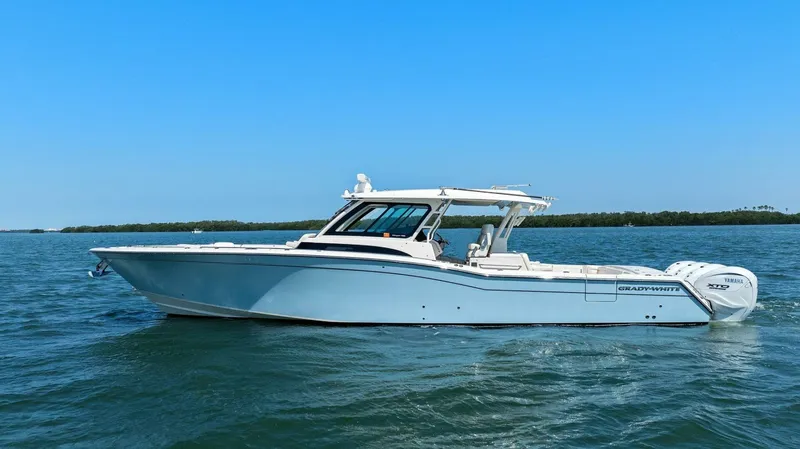
The Grady-White model that is most prominently featured in the current production lineup is the Freedom 415, a 41.5-foot dual console. Introduced in 2024 as the brand’s newest flagship, the Freedom 415 is presented on Grady-White’s official site as the largest outboard-powered dual console the company has produced and is highlighted across the manufacturer’s lineup and innovation pages, indicating its strategic importance to the brand. Its size and dual-console layout represent a sweet spot for Grady-White by combining offshore capability with family-friendly amenities and flexibility, and the model’s placement on the company website, emphasis in recent marketing messaging and designation as a flagship model serve as primary indicators of its prominence. While Grady-White does not publish volume sales figures on the public site, the Freedom 415’s official introduction in 2024, its positioning as the largest outboard dual console in the brand’s history and its central role in current product literature and dealer materials collectively support treating it as the brand’s core offering in the dual-console category. The company’s promotional focus on the model and its availability through Grady-White’s dealer network further underscore the Freedom 415’s significance within the current lineup.

Key published specifications for the Freedom 415 include a length overall of 41.5 feet, a beam of 13 feet, a draft of about 3 feet, an approximate dry weight near 18,000 pounds, a fuel capacity of 500 gallons, and a passenger capacity listed up to 16 people. Standard and highlighted features on Grady-White’s model information and brochures emphasize a spacious cockpit with multiple seating zones, a forward lounge area, an enclosed head compartment and extensive storage, with optional amenities such as a wet bar and grill to support day cruising and entertaining. The design balances fishing functionality and family use by incorporating dedicated storage solutions, configurable seating arrangements and layouts that allow buyers to prioritize fishing stations or additional creature comforts; Grady-White positions the Freedom 415 for family cruising, offshore fishing, day trips and overnight excursions. Power is provided by outboard propulsion, with the Freedom 415 described by the manufacturer as the largest outboard-powered dual console it has built, and the platform is offered with configurations and options intended to suit different buyer needs and mission profiles; specific engine packages and performance figures are provided through dealer channels and official configuration documents. Grady-White positions the Freedom 415 as engineered to deliver offshore-capable performance with long-range capability supported by its 500-gallon fuel capacity, while the model’s optional packages and modular layouts allow owners to prioritize fishing features, entertainment amenities or extended cruising accommodations according to their intended use.

The Freedom 415 is positioned to appeal to buyers seeking a true multiuse offshore platform, and Grady-White's official materials identify family cruising, offshore fishing, day trips and overnight excursions as primary target uses. At 41.5 feet overall with a 13-foot beam and a shallow 3-foot draft, the design balances seakeeping and onboard space to serve extended day use while accommodating larger groups up to 16 people, and the standard layout elements, a spacious cockpit with ample seating, forward lounge area, enclosed head compartment and multiple storage lockers, are explicitly presented by the factory as enabling both fishing functionality and comfortable family amenities. The factory lists a fuel capacity of 500 gallons and an approximate dry weight near 18,000 pounds as part of the published specification set, numbers that underline the Freedom 415’s capability for longer range cruising and for supporting heavy outfitting, and optional features such as a wet bar and grill plus multiple interior and cockpit configurations support convertible seating and dual-purpose spaces that can be arranged for angling, entertaining or overnight comfort. The manufacturer's messaging around the model frames it as the largest outboard-powered dual console the company has built and emphasizes that the Freedom 415 reflects a deliberate design philosophy to expand capacity and versatility in response to customer demand and to showcase Grady-White’s continued focus on innovation.

On availability, Grady-White markets the Freedom 415 as a current production model introduced in 2024 and features it prominently across its official website and product pages, and the company directs prospective buyers to its national dealer network for pricing and delivery information with pricing available upon request from dealers; this placement on model lineup pages and the emphasis in Grady-White communications indicate active production and dealer-channel distribution rather than a concept or limited run. The Freedom 415 is presented in Grady-White materials as the newest flagship dual console and a focal point of recent marketing and model announcements, and the company’s public information highlights the model’s role in addressing demand for larger outboard-powered platforms. While Grady-White does not publish a run-rate number on the website, the level of detail in published specifications, the highlighted position on model pages and the availability of multiple layouts and factory options point to sustained brand investment in the line. For these reasons Grady-White positions the Freedom 415 as a signature offering in its dual console segment, with the combination of 41.5-foot length, heavy fuel capacity, multiple configuration choices and outboard propulsion forming the feature set that the company emphasizes when describing the boat’s market fit and broad buyer appeal.

WHAT IS THE HISTORY OF THIS BOAT BRAND AND COMPANY?

1959 marks the founding of Grady-White by Glen Grady and Don White in Greenville, North Carolina, and the brand name combines the founders' surnames to reflect their partnership. The company began by crafting small, handcrafted wooden boats built with flared bows and lapstrake sides designed for durability and performance in coastal waters, and those first models were intended to meet the needs of local anglers and boaters seeking reliable offshore handling. Early design influences emphasized stout construction and effective hull shapes rather than named naval architects, and the original factory in Greenville produced these wooden runabouts and utility boats using traditional boatbuilding methods. In its initial growth phase Grady-White established an identity for rugged, sea-ready boats through these early design choices and workmanship, which set the stage for later transitions in materials and design.

After Eddie Smith acquired the company in 1968 he guided a major transformation as Grady-White transitioned from wooden construction to fiberglass which improved durability and helped standardize production, and under that new leadership the company introduced innovations such as the SeaV² hull design to deliver a smoother, more stable ride while expanding its model range to include center consoles, dual consoles and cabin boats. Throughout the 1990s and 2000s Grady-White continued to introduce notable models including the Marlin 28 introduced in 1989 and the Express 330 released in 2001 which garnered acclaim for design and performance, and the company emphasized customer satisfaction earning the National Marine Manufacturers Association Customer Satisfaction Index Award for 16 consecutive years through 2018. Leadership continuity and industry recognition continued into the next decade with President Kris Carroll being inducted into the NMMA Hall of Fame in 2020 after 45 years with the company and as of 2025 Grady-White remains focused on building a diverse range of center console, dual console and cabin models while official manufacturer histories highlight product development, customer service and quality more than detailed public accounts of factory relocations or specific downturns in the 1990s.

After Eddie Smith acquired Grady-White in 1968 the company moved from handcrafted wooden boats to fiberglass construction, a change that improved durability and allowed for more consistent production. Engineering advances included development of the SeaV² hull design which the company credits with delivering a smoother more stable ride in coastal conditions, and Grady-White broadened its model range to address varied fishing and family boating markets by adding center consoles dual consoles and cabin boats. Signature models through the 1980s 1990s and early 2000s illustrated that evolution with boats such as the Marlin 28 introduced in 1989 and the Express 330 introduced in 2001 which the manufacturer highlights for their design and performance, and the company underlined its commitment to owners by earning the National Marine Manufacturers Association Customer Satisfaction Index Award for 16 consecutive years through 2018.

Leadership and stewardship have been important to Grady-White's modern identity with long serving executives such as Kris Carroll who was inducted into the NMMA Hall of Fame in 2020 after 45 years with the company, and as of 2025 the company continues to build a diverse lineup of center consoles dual consoles and cabin boats while emphasizing quality customer service and owner satisfaction as core brand values. The name Grady-White itself combines the founders Glen Grady and Don White and reflects the companys roots in handcrafted coastal boats, and today the brand positions itself as a premium American boatbuilder with a history of design innovation rigorous construction standards and sustained customer satisfaction that the manufacturer cites as the foundation for ongoing customer trust and the companys future outlook.

AWARDS AND RECOGNITIONS

Grady-White’s modern award history begins with the Marine Marketers of America Neptune Awards in 2017 when the company’s Docklines e-newsletter and its digital content syncing system were honored with Best Newsletter and Marketing Innovation for marketing excellence and platform innovation. Building on that visibility, Grady-White repeatedly earned recognition from the National Marine Manufacturers Association through its Customer Satisfaction Index, receiving the 17th consecutive NMMA CSI Award in the Fiberglass Outboard Boats category in 2018 and the 18th in 2019, acknowledgments that highlighted the brand’s product quality and ownership experience as measured by the industry’s independent CSI program. In 2020 Grady-White’s leadership was further recognized when Kris Carroll, President of Grady-White, was inducted into the NMMA Hall of Fame for individual achievement, honoring her 45 years of service to the company and the recreational boating industry. Subsequent NMMA CSI milestones include the 20th consecutive award in 2022 and the 21st in 2023, each reinforcing a history of sustained performance and dealer support documented by the issuing organizations.

Grady-White’s track record with the NMMA Customer Satisfaction Index culminated in a notable run of consecutive honors, reaching its 22nd consecutive NMMA CSI Award in 2024 and its 23rd in 2025 in the Fiberglass Outboard Boats category, a streak confirmed in Grady-White releases and NMMA reporting. The NMMA CSI award is an independently administered program that measures owner satisfaction through surveys covering product quality, performance, dealer support and overall ownership experience, and Grady-White’s consistent 90 percent or higher ratings in program years cited by the company underscore why the brand has been repeatedly recognized. That continuity demonstrates both operational consistency and customer loyalty, and when paired with industry marketing accolades such as the Neptune Awards for Best Newsletter and Marketing Innovation in 2017 and again for marketing work recognized in 2025, it paints a picture of a company that invests in both product excellence and customer communication. Taken together these awards document decades of sustained recognition by recognized marine organizations and industry peers.

From 2023 through 2025 Grady-White's most prominent industry recognitions have centered on sustained owner satisfaction and marketing innovation, as documented in the company's public announcements and by the National Marine Manufacturers Association and Marine Marketers of America. In 2023 Grady-White earned its 21st consecutive NMMA Customer Satisfaction Index Award in the Fiberglass Outboard Boats category, an accolade that reflects independently measured owner ratings and dealer service performance. The company followed that in 2024 with a 22nd consecutive NMMA CSI Award, again meeting the NMMA benchmark of 90 percent or higher in customer satisfaction for the program year, and in 2025 Grady-White extended the streak to 23 consecutive CSI Awards, reinforcing an ongoing pattern of high owner satisfaction across its fiberglass outboard models. Also in 2025 Grady-White received Neptune Awards for Marketing Excellence from Marine Marketers of America, with honors in Best Newsletter for their Docklines e-newsletter and for Marketing Innovation for a digital content syncing system, recognitions that highlight the brand's investment in owner communication and digital engagement rather than individual model competitions.

Looking back across the brand's documented recognitions, including earlier Neptune Awards in 2017, multiple CSI awards through the late 2010s and 2020s, and the 2020 National Marine Manufacturers Association Hall of Fame induction of company president Kris Carroll for her decades of service, the pattern is clear: Grady-White has been repeatedly validated by established industry organizations for product quality, customer service and leadership. These awards collectively emphasize consistent owner satisfaction, effective dealer support networks, and a willingness to innovate in marketing and customer outreach; they also underscore executive leadership that has been influential industrywide. For a prospective buyer these third party honors from the NMMA and Marine Marketers of America provide documented evidence of long term reliability and brand stewardship, supporting confidence that Grady-White designs and customer programs are built around durability, serviceability and owner experience rather than short term trends.

Be the First to Know

Get notified when new boats become available.

Logo